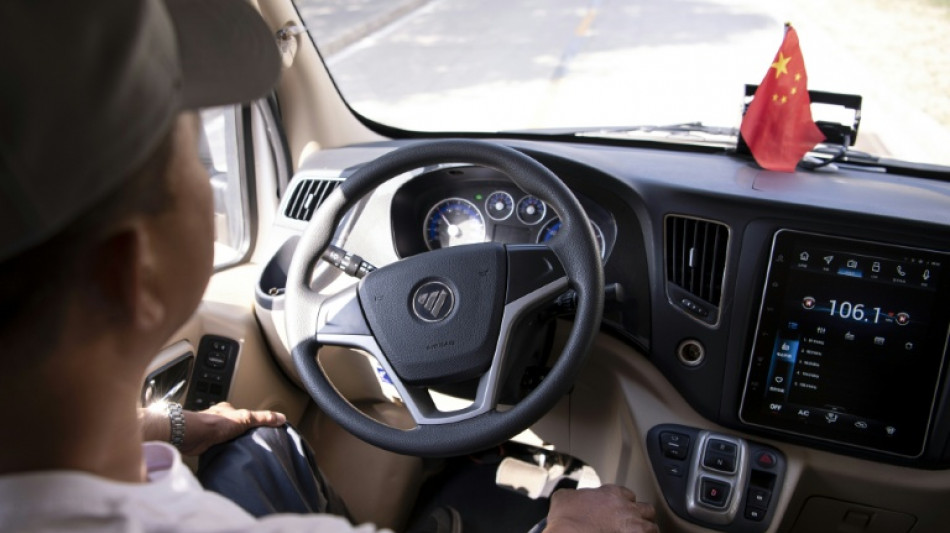
China top court says drivers responsible despite autonomous technology / Photo: © AFP/File
China's top court has issued a ruling confirming humans in cars with assisted driving technology are responsible for their vehicle, setting a nationwide benchmark as Beijing positions itself as a standards-setter in the auto market.
In its ruling the court referred to a case in which a man relied on the technology while drunk and asleep at the wheel.
Chinese tech companies and carmakers have poured billions of dollars into autonomous driving technology in the race to outperform each other, as well as rivals in the United States and Europe.
However, Beijing has moved to tighten safety rules after a high-profile crash last March.
Drivers are still responsible for ensuring road safety after activating assisted driving functions, China's top court said in a "guiding case" issued on Friday.
The reference case is a September ruling in southern Zhejiang province, in which a driver surnamed Wang was jailed and fined for fully relying on the assisted driving system while drunk.
Wang installed a device to mimic hand grip on the steering wheel, set the car to drive then fell asleep in the passenger seat, the court said.
Police found Wang after the car stopped in the middle of a road.
"The on-board assisted driving system cannot replace the driver as the primary driving subject," the Supreme People's Court said in the Friday ruling.
The driver "is still the one who actually performs the driving tasks and bears the responsibility to ensure driving safety", it added.
While most such systems currently used on the road specify that the driver is ultimately in control of the car, the court's ruling now makes that a legal standard nationwide.
Lower courts are to reference the judgement when deciding on similar cases.
Beijing had already warned leading automakers that safety rules would be more tightly enforced after a crash that killed three college students last March raised concerns over the advertising of cars as being capable of autonomous driving.
Friday's guidance comes after China announced it will ban hidden door handles on cars, a minimalist design popularised by Tesla, from next year -- also over safety concerns.
Folding into the body of the car, such door handles help reduce drag while in motion but are prone to losing operability in the event of a crash.
One high-profile incident occurred in October, when rescuers were shown failing to open the doors of a burning electric vehicle in the southwestern city of Chengdu.
Q.Marshall--TNT