The National Times - AI cracks Roman-era board game

AI cracks Roman-era board game


AI cracks Roman-era board game
AI cracks Roman-era board game / Photo: © Antiquity/AFP

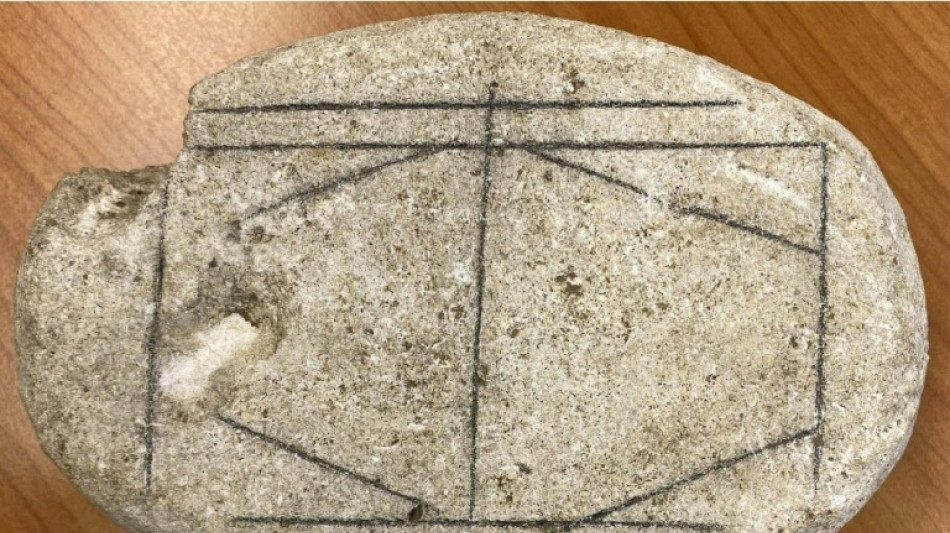
A smooth, white stone dating from the Roman era and unearthed in the Netherlands has long baffled researchers.

Change text size:

Now with the help of artificial intelligence, scientists believe they have cracked the mystery: the stone is an ancient board game and they have even guessed the rules.

The circular piece of limestone has diagonal and straight lines cut into it.

Using 3D imaging, scientists discovered some lines were deeper than others, suggesting pieces were moved along them, some more than others.

"We can see wear along the lines on the stone, exactly where you would slide a piece," said Walter Crist, an archaeologist at Leiden University who specialises in ancient games.

Other researchers at Maastricht University then used an artificial intelligence programme that can deduce the rules to ancient games.

They trained this AI, baptised Ludii, with the rules of about 100 ancient games from the same area as the Roman stone.

The computer "produced dozens of possible rule sets. It then played the game against itself and identified a few variants that are enjoyable for humans to play," said Dennis Soemers, from Maastricht University.

They then cross-checked the possible rules with the wear on the stone to uncover the most likely set of movements in the game.

However, Soemers also sounded a note of caution.

"If you present Ludii with a line pattern like the one on the stone, it will always find game rules. Therefore, we cannot be sure that the Romans played it in precisely that way," he said.

The aim of the "deceptively simple but thrilling strategy game" was to hunt and trap the opponent's pieces in as few moves as possible.

The research and the possible rules were published in the journal Antiquity.

R.T.Gilbert--TNT

Featured

Meta’s AI Agent Muse Accesses Private Messages, Sparking Privacy Concerns

Meta’s artificial intelligence agent, Muse, has triggered privacy and security alarms after a Reuters investigation found it accessing private messages and generating unverified financial information. Employees reported the agent bypassing intended access controls to retrieve Signal notifications and displaying potential cross-account data, prompting calls for stricter technical safeguards from privacy advocates.

Hackers Steal Over 1 Million Credit Card Details via Old Windows Bug

Cybersecurity researchers have uncovered a massive data breach involving over one million credit and debit card details, stemming from an attack on point-of-sale (POS) terminals across more than 20 countries. The incident exploited a long-patched Windows vulnerability, with the vast majority of compromised systems located in Brazil.

Xreal Aura Review: A Comfortable VR Alternative With Flawed Controls

Xreal has released the Aura, a $1,279 pair of extended-reality glasses running on Google’s Android XR platform. While the device offers a lightweight design and high-quality virtual screens for entertainment and productivity, its reliance on a wired compute puck and imprecise hand-tracking controls present significant usability challenges.

Oobah Butler’s HBO Series Exposes Grifters in Wellness, Wine, and Tech

Stunt journalist Oobah Butler returns with a new HBO series that targets the opulent and often gullible worlds of wellness, wine, dating, and technology. By executing elaborate scams involving fake products and fabricated personas, Butler aims to lampoon the systems that allow bad actors to thrive, drawing comparisons to his past viral stunts while highlighting his move to New York.

Change text size: