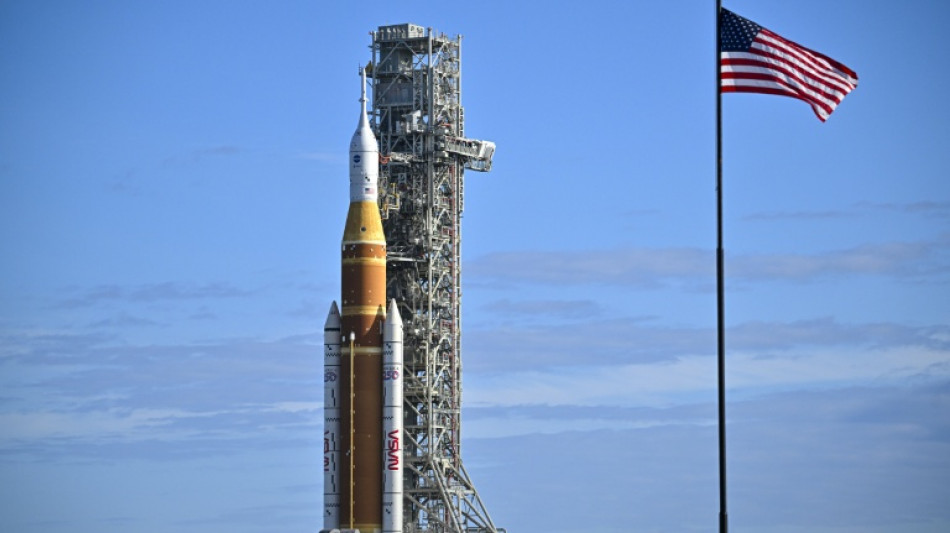
NASA moves moon rocket to launch pad ahead of Artemis 2 mission / Photo: © AFP
NASA on Saturday rolled out its towering SLS rocket and Orion spacecraft as it began preparations for its first crewed mission to the Moon in more than 50 years.
The maneuver, which takes up to 12 hours, will allow the US space agency to begin a string of tests for the Artemis 2 mission, which could blast off as early as February 6.
The immense orange and white Space Launch System rocket and the Orion vessel were slowly wheeled out of the Vehicle Assembly Building at the Kennedy Space Center in Florida, and painstakingly moved four miles (6.5 kilometers) to Launch Pad 39B.
If the tests are all satisfactory, three Americans and one Canadian will head to the Moon sometime between February 6 and the end of April -- they will not land, but instead fly around Earth's satellite.
The mission -- which would last about 10 days -- would be a huge step towards Americans once again setting foot on the lunar surface, a goal announced by President Donald Trump in his first term.
"We're making history," Artemis 2 mission management team chair John Honeycutt told a press conference on Friday.
- 'Pretty pumped' -
US astronauts Reid Wiseman, Victor Glover and Christina Koch, along with Canada's Jeremy Hansen, were on site Saturday for the rocket's rollout.
"I'm actually pretty pumped to see that," Hansen told reporters. "In just a few weeks, you're going to see four humans fly around the moon, and if we're doing that now, imagine what we can do next."
Glover added: "We're swinging for the fence, trying to make the impossible possible."
Before the mission can take off, engineers must ensure the SLS rocket is safe and viable. After a battery of tests, a pre-launch simulation will be carried out.
The uncrewed Artemis 1 mission took place in November 2022 after multiple postponements and two failed launch attempts.
NASA hopes to put humans back on the Moon as China forges ahead with a rival effort that is targeting 2030 at the latest for its first crewed mission.
Its uncrewed Chang'e 7 mission is expected to be launched in 2026 for an exploration of the Moon's south pole, and testing of its crewed spacecraft Mengzhou is also set to go ahead this year.
NASA is hoping that the Moon could be used to help prepare future missions to Mars.
But the program has been plagued by delays.
The US space agency surprised many late last year when it said Artemis 2 could happen as soon as February -- an acceleration explained by the Trump administration's wish to beat China to the punch.
Artemis 3, currently scheduled for 2027, is expected to be pushed back, as industry experts say Elon Musk's SpaceX is behind on delivering the Starship megarocket needed for the mission.
H.Davies--TNT