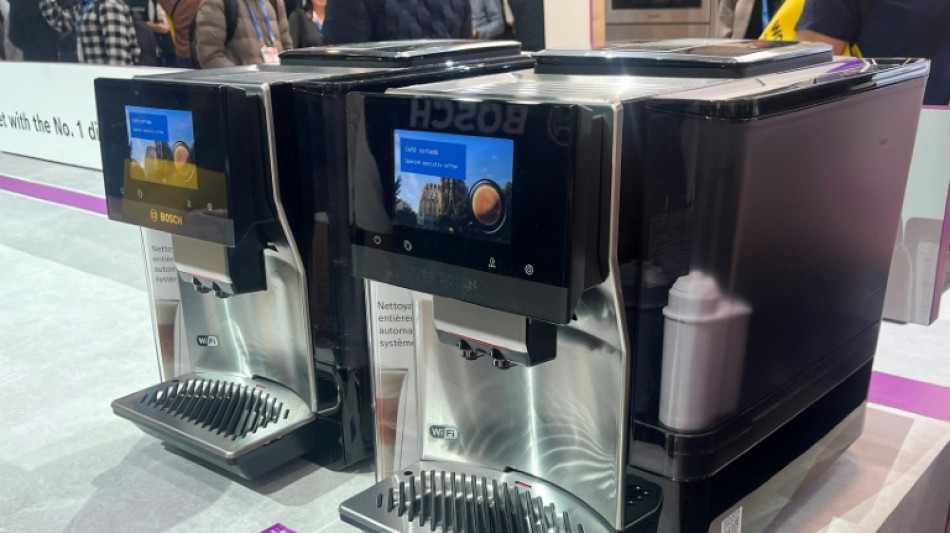
Brew, smell, and serve: AI steals the show at CES 2026 / Photo: © AFP
AI took over CES 2026, powering coffee machines to brew the perfect espresso, a device to create your perfect scent, and ball-hitting tennis robots that make you forget it's human against machine.
- Alexa, make me an espresso -
German group Bosch presented a new feature for its fully automated 800 Series coffee machine (sold from $1,700) that can be synchronized with Amazon's Alexa voice assistant.
After a short night's sleep, users can order a double espresso with voice commands only, and the coffee maker will deliver. Some 35 different espresso options are available.
"We're one of the first manufacturers to really lean in with AI," explained Andrew de Lara, spokesperson for Bosch.
The century-old company, positioned at the high end of the market in the United States, wants to gradually bring AI into the kitchen, notably through its Home Connect mobile app, which already allows users to control several appliances remotely.
- Scent of AI -
South Korean company DigitalScent has developed a machine, already available in some airports, that creates a personalized fragrance based on your mood and preferences.
Once you have picked your preferences, it releases a scent that gives you an idea of the final result. You can then make adjustments before making your final decision.
Once you have placed your order, the machine uses AI to produce a virtually unique fragrance in a matter of seconds, choosing from a range of over 1,150 combinations.
The fragrance is contained in a small, portable vial, costing $3 to $4, according to a spokesperson.
- Game, set, AI -
Several start-ups unveiled new-generation ball machines powered by artificial intelligence.
While Singapore-based Sharpa already offers a convincing humanoid table tennis robot with a reaction time of just two hundredths of a second, there is no equivalent on the market for tennis.
A few days ago, China's UBTech posted a video online of its Walker S2 robot playing rallies with a human, but at a slow speed and without any real movement.
UBTech's robots are designed for industrial use rather than tennis courts and, in all likelihood, the video was produced solely to demonstrate the agility of the Walker S2 to attract business customers.
While we wait for the humanoid robot that can volley at the net, another Chinese company, Tenniix, is marketing a robot that sends balls at speeds of up to 75 miles per hour (120.7 kilometers per hour).
It has 10 different shots, some with spin, and even a lob that reaches eight meters high.
The basic version, which can hold up to 100 balls, will set you back $699, but the most complete version, at $1,600, includes cameras and wheels that allow it to move around.
The fast-moving machine uses AI to analyze the trajectory of your cross-court forehand and fires off a ball from about where a real-life return shot would most likely come, giving the player the impression of a real rally.
"There's a real rhythm," says Run Kai Huang, spokesperson for Tenniix, "as if you were playing with a real person."
F.Lim--TNT