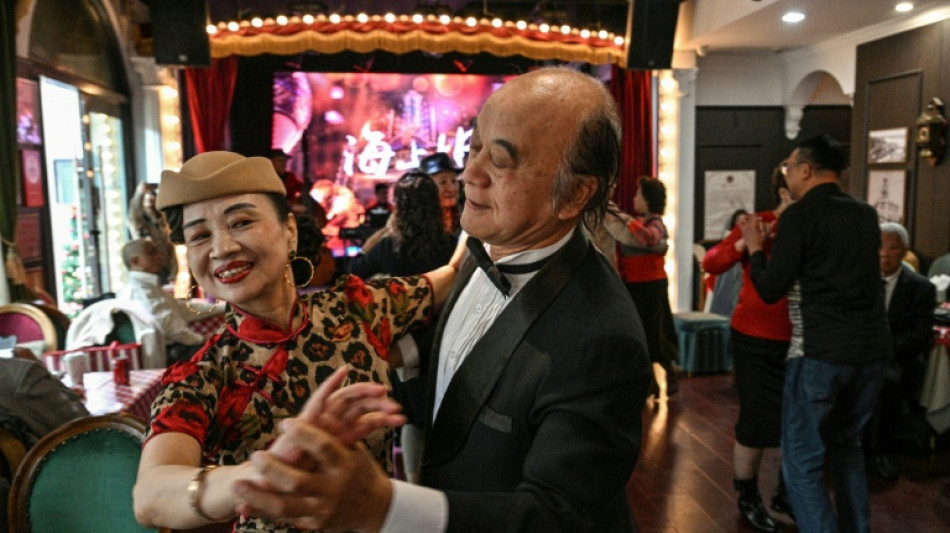
Shanghai's elderly waltz back to the past at lunchtime dance halls / Photo: © AFP
A group of retirees cheered under disco lights as 60-year-old Xu Li leapt into her partner's arms, her legs spread akimbo in perfect splits.
It was just a regular Wednesday at one of Shanghai's many lunchtime dance clubs, a phenomenon born of the city's deeply rooted love of ballroom culture from its jazz-age heyday.
On any given day, multiple venues host hours-long daytime sessions across the finance hub, some starting as early as 6 am.
Establishments such as the historic Paramount Ballroom are time capsules from the 1930s, while others flash with neon pink and green rave lights in the early afternoon.
All are important spaces for their mostly elderly clientele to socialise and reclaim the past through the medium of foxtrot, rumba and polka.
"I was quite lonely at home," 66-year-old Lin Guang told AFP at a dance hall called Old Dreams Of Shanghai in December, explaining he had felt lost after retiring.
"Coming here to dance makes me feel young again. Now, I seem to have endless energy."
Wine-red velvet curtains and cabaret lights framed the sprung wooden floor as a live band played Shanghai jazz classics.
Women, some dressed in vintage gowns or sleek traditional qipao dresses, took out elegant dance shoes, while the men's footwear was meticulously polished and their hair neatly combed.
"We want to recreate a bit of old Shanghai culture," said 69-year-old bandleader Jin Zhiping.
For him and his similarly aged bandmates, the lunchtime sessions, priced at 60 yuan ($8.5), are a source of purpose.
"It lifts our spirits, and makes us feel we still have value," said Jin.
For Xu, the athletic sexagenarian, the benefits of exercising are "tremendous".
"I feel beautiful, and I'm becoming more and more beautiful as time goes on," she said.
- 'Like my home' -
In 1930s Shanghai, ballroom dancing symbolised modernity and sophistication.
"Shanghai is a port city," said Chen Yiming, the entrepreneur behind Old Dreams Of Shanghai. "We absorbed foreign cultures and blended them with our own."
The art deco Paramount Ballroom was a must-visit destination, counting warlords, poets and actor Charlie Chaplin among its visitors.
These days, it still opens its heavy brass doors daily, an elevator transporting a steady stream of guests back almost a century in time for 180 yuan each.
Wei Xiaomeng, 90, comes to the Paramount Ballroom five times a week.
"This ballroom is like my home," she told AFP.
She first snuck into a dance hall as a curious middle school student.
"I thought it was luxurious, and I loved it," she said.
As a waltz began, couples swept across the floor, hands clasped and feet moving in perfect synchronisation under the gilded cornices and glittering chandeliers.
"That feeling of loneliness? It's completely gone here," smiled 75-year-old Yuan Yingjie. "It's a familiar, homely feeling."
Fafa, a 70-year-old who visits the venue three times a week, put it simply: "Here, it's all joy."
- 'Just old, not dead' -
Old Dreams Of Shanghai's Chen said for elderly clientele, dance halls are gyms, entertainment venues and social clubs rolled into one.
"An elderly person is just old, not dead. They have the same social and entertainment needs as anyone," she said.
But there are concerns the average age of the dancers could see this quintessential Shanghai phenomenon slowly die out.
It is unclear how many of these dance halls still exist. AFP found around a dozen online, while a recent local media report suggested around 20 still operate.
"Promoting dance culture to a younger generation is actually very necessary," said the Paramount's executive director, 33-year-old Stella Zheng.
In-person contact was especially important in China's hyper-digitalised society, she said.
"The exchange of glances, body language... you can listen to music, make friends through dance."
The Paramount hosts parties for young people in collaboration with other dance institutions, and plans to offer classes in styles like modern and Latin.
Chen said she had observed a growing retro trend.
"More and more young people are starting to join in to dance modern or swing," she said.
Older dancers are excited to share the floor.
"We truly hope young people come," said Wang Li, 65.
"Young people have an energy, a bright liveliness. Being with them makes us feel younger too."
V.Allen--TNT