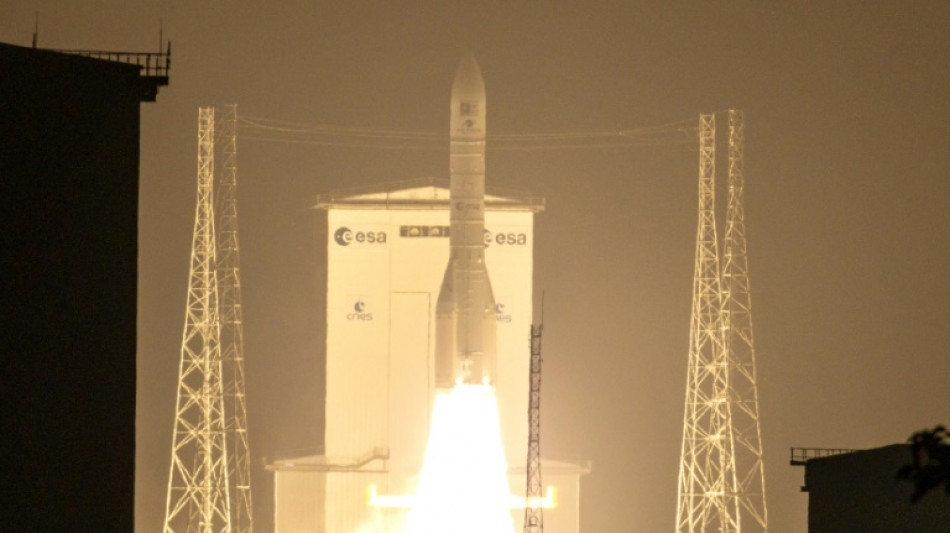
Europe's Ariane 6 rocket puts EU navigation satellites in orbit / Photo: © AFP
Europe's new Ariane 6 rocket successfully placed two satellites into orbit to join the EU's rival to the GPS navigation system on Wednesday after the mission blasted off from French Guiana.
It was the fourth commercial mission of the Ariane 6 launch system since the long-delayed single-use rockets came into service last year.
The rocket launched into cloudy skies from Europe's spaceport in Kourou on the northeastern coast of South America at 2:01 am local time (0501 GMT).
It was carrying two more satellites of the European Union's Galileo programme, a global navigation satellite system that aims to make the bloc less dependent on the US's Global Positioning System (GPS).
Applause rang out at the spaceport minutes before 7:00 am local time (1000 GMT) as it was confirmed that the satellites had been successfully deployed into orbit 23, 000 kilometres (14,000 miles) above Earth's surface.
They will bring to 34 the number of Galileo satellites in orbit.
This addition will also "improve the robustness of the Galileo system by adding spares to the constellation to guarantee the system can provide 24/7 navigation to billions of users", according to the European Space Agency (ESA) which oversees the programme.
According to the EU, Galileo is four times more accurate than GPS, providing navigation accuracy of up to one metre.
The "successful" launch also reinforces "Europe's resilience and autonomy in space", the ESA said on X.
- Reusable rockets wanted -
Previous Galileo satellites were primarily launched by Ariane 5 and Russian Soyuz rockets from Kourou.
After Russia's invasion of Ukraine, Europe halted space cooperation with Moscow.
The loss of Russia's Soyuz rockets -- and repeated delays to Ariane 6 -- left Europe without an independent way to blast missions into space for several months.
Before Ariane 6's first commercial flight in March this year, the ESA resorted to contracting billionaire Elon Musk's SpaceX to launch two Galileo satellites in September 2024.
Ariane 6 also blasted a weather satellite into orbit in August followed by a satellite for the EU's observation programme Copernicus last month.
Arianespace, the operator of the rocket system, in September reduced by one the number of commercial launches on Ariane 6 this year, vowing to roughly double its number of missions in 2026.
The next mission, planned for the first quarter of 2026, will be the first to use a four-booster version of Ariane 6, rather than the current two.
It is scheduled to launch 34 satellites for the constellation of billionaire Jeff Bezos's Amazon. The constellation, formerly known as Project Kuiper, was recently renamed Amazon Leo.
SpaceX has risen to dominate the booming commercial launch industry by developing rockets that are reusable -- which Ariane 6 is not.
"We have to really catch up and make sure that we come to the market with a reusable launcher relatively fast," ESA director Josef Aschbacher told AFP in October.
Several European aerospace firms are now bidding to develop the system for the ESA.
P.Johnston--TNT