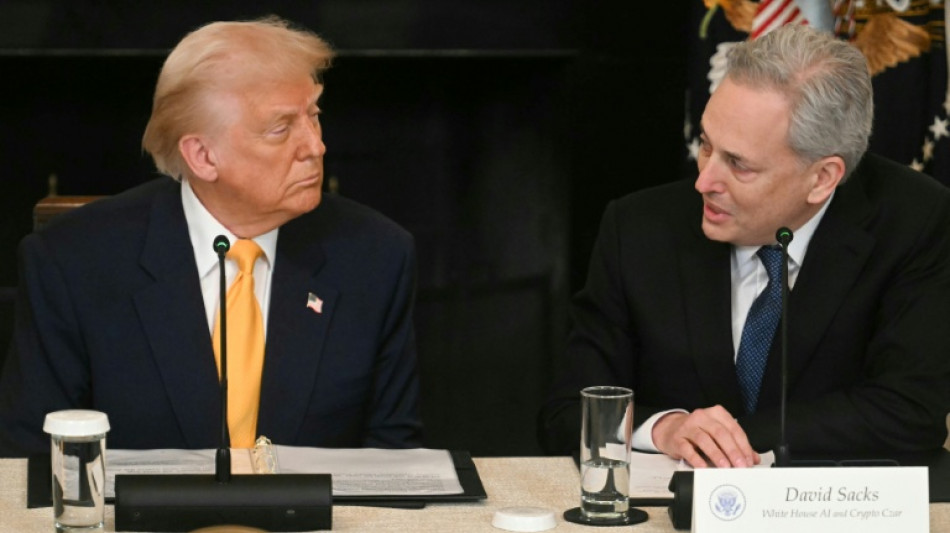
Trump says to sign order blocking AI regulation by states / Photo: © AFP
President Donald Trump said Monday he will attempt to strip states of the right to regulate the surging AI industry, arguing centralized rulemaking is vital to maintain US dominance.
"There must be only One Rulebook if we are going to continue to lead in AI," he posted on his Truth Social platform, announcing an executive order that would seek to prevent state-level regulation.
Trump has made a major play to position the United States at the head of the global race to build and control AI tools predicted to transform everything from the way the economy works to military technology.
However, the White House is running up against deep skepticism in Congress and within his own MAGA movement, where many voices are wary of the technology's potential economic and social harms.
They point to polls that show increasing concern about AI, especially among young people who are nervous about getting or keeping a job.
Figures within his own MAGA movement, such as strategy guru Steve Bannon, complain of Trump's closer ties to Big Tech that put the president out of touch with his political base.
The announcement that he will sign an executive order centralizing AI regulation comes after Congress has twice refused to vote for allowing the overriding of state-level laws on AI.
"We are beating ALL COUNTRIES at this point in the race, but that won't last long if we are going to have 50 States, many of them bad actors, involved in RULES and the APPROVAL PROCESS," Trump wrote in his post.
"THERE CAN BE NO DOUBT ABOUT THIS! AI WILL BE DESTROYED IN ITS INFANCY! I will be doing a ONE RULE Executive Order this week."
The order is likely to stir more political opposition and legal challenges even if no details are yet known about what it would say.
A draft order seen by The Hill last month would have created a task force dedicated to challenging state AI laws and restricted certain broadband funding for states with AI laws deemed overly burdensome.
The idea to stop states going their own way has been advanced by Trump's AI and Crypto Czar David Sacks, a Silicon Valley insider, with the support of AI's biggest players, including OpenAI boss Sam Altman and Nvidia CEO Jensen Huang.
"State by state AI regulation would drag this industry to a halt, and it would create a national security concern as we need to make sure that United States advances AI technology as quickly as possible," Huang told reporters during a visit to US Congress last week.
Industry bosses complain that there are more than 1,000 AI-related bills currently moving through state legislatures.
"How do you cope with those varied regulations (and)compete with countries like China, which are moving fast in this technology?" Google CEO Sundar Pichai told "Fox News Sunday."
T.F.Russell--TNT