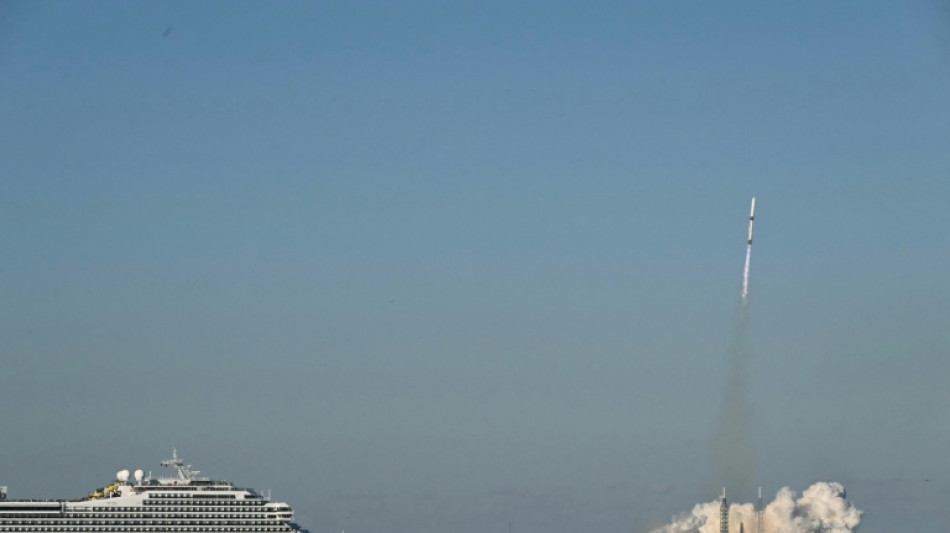
Blue Origin launches NASA Mars mission and sticks booster landing / Photo: © AFP
Jeff Bezos's Blue Origin successfully launched its New Glenn rocket on Thursday with NASA twin spacecraft destined for Mars aboard, and in a breakthrough stuck the landing of its booster.
The launch was stalled for days over weather both on Earth and in space, but it was worth the wait: in the rocket's second-ever flight, Blue Origin managed to recover the booster for reuse.
Ecstatic cheers rang out at the launch site in Florida's Cape Canaveral as the booster gracefully nailed its landing on a floating platform. Prior to Thursday, only Elon Musk's SpaceX had managed to accomplish such a maneuver with an orbital-class rocket.
Blue Origin's accomplishment comes amid intensified rivalry between the two billionaire-owned private space companies, as the US space agency NASA recently opened up bids for its planned Moon mission.
"Damn that was exciting!" said Jared Isaacman -- a Musk ally who President Donald Trump recently nominated again to head NASA -- on X, congratulating Blue Origin.
A handful of figures at SpaceX also had praise for their rivals, with their VP of Launch, Kiko Dontchev, saying the feat "moves the country and industry forward."
The launch was repeatedly delayed: on Sunday over weather on Earth, and on Wednesday over weather in space.
The second postponement was over "highly elevated solar activity" that NASA was worried could impact or damage its spacecraft.
And multiple glitches meant delays yet again on Thursday -- hold-ups Blue Origin did not explain. But at 3:55 pm (2055 GMT), New Glenn finally blasted off.
The 322-foot (98-meter) rocket now has the task of sending NASA's ESCAPADE twin spacecraft to Mars, in a bid to study the Red Planet's climate history with the eventual hope of human exploration.
Applause resounded once more as the spacecraft successfully deployed.
Joseph Westlake, a NASA heliophysicist, explained during Thursday's webcast how the twin spacecraft named "Blue" and "Gold" will first finding a "benign, safe parking orbit" to make "measurements about the space weather here on Earth."
Then, once the planets have reached the ideal alignment in the fall of 2026, the spacecraft will get a boost from Earth's gravity and begin the journey to Mars, where they will arrive in 2027.
This type of launch could allow for more frequent missions in the future, because they could proceed outside the window of direct alignment of Earth and Mars that happens approximately once every two years.
- 'Launch, land, repeat' -
New Glenn's inaugural flight in January also was marked a success, as its payload achieved orbit and successfully performed tests.
But its first-stage booster, which was meant to be reusable, was lost during descent.
Thursday's achievement signals that Blue Origin is on its way to reducing costs by reusing boosters rather than allowing them to plummet into the ocean.
"Launch, land, repeat -- it starts today," said Eddie Seyffert, among Blue Origin's webcast commentators.
And it comes as US President Donald Trump's second term in the White House has seen the administration pile pressure on NASA to accelerate its progress to send a crewed mission to the Moon amid a race with China.
George Nield -- a senior aerospace executive whose work promotes the commercial space industry, and who has flown with Blue Origin in the past -- told AFP this launch would be an "indicator" of the company's progress.
It could show "whether they can play increased roles in near-term lunar exploration," he said.
S.Collins--TNT