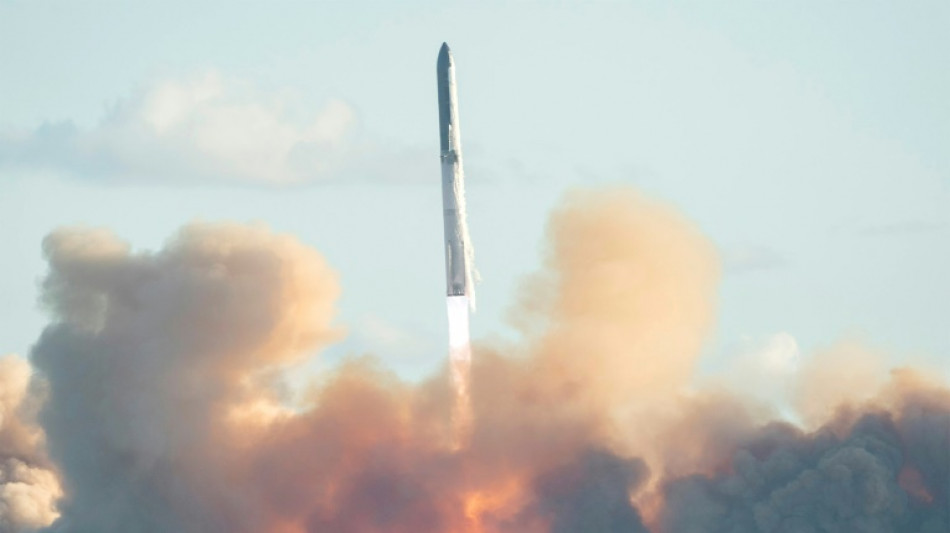
SpaceX's launches Starship megarocket on successful test flight / Photo: © AFP
SpaceX's massive Starship rocket soared through Texas's golden-hour skies Monday before splashing down successfully, as the US company vies to silence critics who doubt Elon Musk's startup can deliver NASA's lunar projects on time.
In its 11th test voyage, the enormous rocket took off Monday from Space X's south Texas launch facilities just after 6:25pm local time (2325 GMT), according to a live video feed which also featured resounding applause from engineering teams.
Its rocket booster known was Super Heavy landed in Gulf waters as planned, while the upper stage, also known individually as Starship, cruised through space and ran through tests, charting a similar path to the last successful mission in August.
It blazed into the Indian Ocean a little over an hour post-liftoff, having released mock satellites as it had on its previous flight. There was no recovery of the vehicle planned.
NASA plans to use the mammoth Starship -- the world's largest and most powerful rocket -- in its efforts to return astronauts to the Moon. It is also key to Musk's zealous vision to take humans to Mars.
The billionaire SpaceX founder said on the webcast prior to launch he was planning to watch outside, rather than inside as he previously had: it's "much more visceral," he said.
Monday's test mission was expected to be the last for this iteration of Starship prototypes. The next flight will debut a new model, Version 3, SpaceX said.
The space technology company could claim its two most recent flights as wins.
But those followed a series of spectacular explosions that raised concerns Starship ultimately might not live up to its promises -- at least not on the timeline lawmakers and the scientific community had hoped for.
The US space agency's Artemis program aims to return humans to the Moon as China forges ahead with a rival effort that's targeting 2030, at the latest, for its first crewed mission.
US President Donald Trump's second term in the White House has seen the administration pile pressure on NASA to accelerate its progress -- efforts Starship is key to.
Musk's company has a multibillion-dollar federal contract to develop a modified version of Starship as a lunar lander.
- 'Second space race' -
The manned Artemis III mission is intended for mid-2027 -- but a NASA safety advisory panel has warned it could be "years late," according to Space Policy Online.
And former NASA administrator Jim Bridenstine told a Senate panel recently that "unless something changes, it is highly unlikely the United States will beat China's projected timeline."
NASA's acting administrator Sean Duffy has insisted the US will still win the "second space race," telling reporters last month that "America has led in space in the past, and we are going to continue to lead in space in the future," while dismissing the notion that China could get there first.
Previous tests of the enormous Starship rocket have resulted in explosions of the upper stage, including twice over the Caribbean and once after reaching space. In June, the upper stage blew up during a ground test.
Musk has identified developing a fully reusable orbital heat shield as the toughest task, noting it took nine months to refurbish the Space Shuttle's heat shield between flights.
Another hurdle is proving Starship can be refueled in orbit with super-cooled propellant -- an essential but untested step for the vehicle to carry out deep-space missions.
NASA's Aerospace Safety Advisory Panel has emphasized "threats" related to ensuring that that vital transfer can be carried out, with member Paul Hill saying the timeline is "significantly challenged."
S.O'brien--TNT