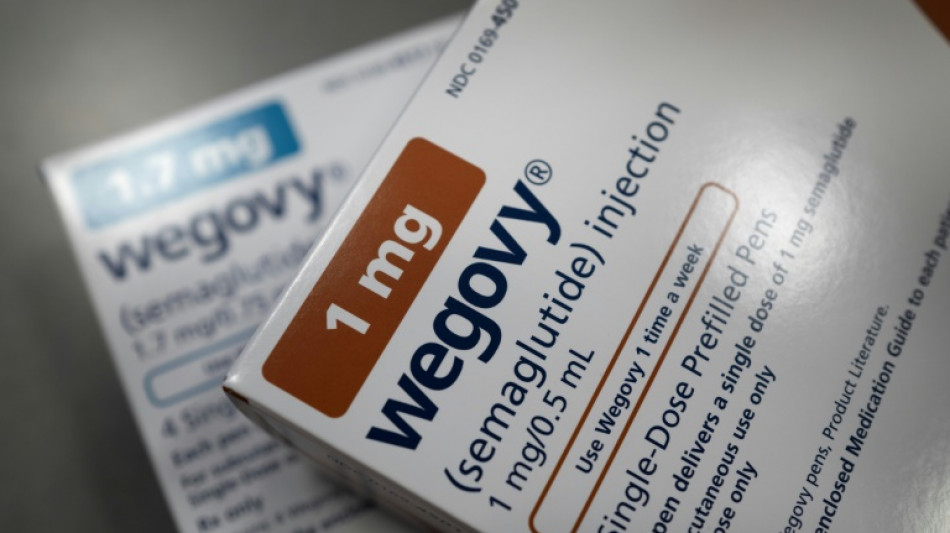
Appetite-regulating hormones in focus as first Nobel Prizes fall / Photo: © GETTY IMAGES NORTH AMERICA/AFP/File
Research into hormones that regulate appetite is seen leading the race for the Nobel Prize in Medicine, to be awarded Monday -- the first in this year's Nobel season.
At a time when more than one billion people suffer from obesity, research into the hormone called "glucagon-like peptide 1" (GLP-1) could be given the nod for the Nobel Prize in Physiology or Medicine this year, experts said.
A new generation of drugs using GLP-1 agonists -- including blockbuster brands Ozempic, Wegovy and Mounjaro -- has provided a valuable tool to fight obesity and diabetes globally.
"Many are guessing that it (the Nobel Prize in Medicine) will go to the people behind GLP-1," Lars Brostrom, science editor at public broadcaster Sveriges Radio, told AFP.
That could help researchers from major US institutions once again dominate the Nobel Prizes in sciences, which are to be announced this week in Stockholm.
But, even if that happens, US politics is to cast a shadow over them, given budget cuts to science programmes ordered by President Donald Trump's government.
Since January, the US National Institutes of Health (NIH) has terminated 2,100 research grants totalling around $9.5 billion and $2.6 billion in contracts, according to an independent database called Grant Watch.
Such cuts could fuel debate over the growing risk that the United States could lose its edge in scientific research.
"In the post-war period, the US has taken over Germany's role as the world's leading scientific nation," Hans Ellegren, secretary general of the Royal Swedish Academy of Sciences, which awards Nobel Prizes in physics, chemistry, and economics, told AFP.
"When they now start cutting research funding, it threatens the country's position."
- Many contenders -
When it comes to GLP-1, as with many other discoveries, it can be hard to narrow down who exactly deserves to be honoured when many scientists around the world have made significant contributions.
Brostrom said some names often speculated upon are Danish physician Jens Juul Holst, and Joel Habener, a professor of medicine at Harvard, as well as Canadian endocrinologist Daniel Drucker and Yugoslav-born American chemist Svetlana Mojsov.
Despite treatments such as Ozempic being recently introduced, and the Nobel Assembly at the Karolinska Institute more often honouring discoveries that are decades old, "it could also be perfect timing" for GLP-1 recognition "because the discovery itself was made back in the 80s", Brostrom said.
In the same field, research on ghrelin, a hormone that stimulates appetite, could earn a Nobel Prize for two Japanese researchers, Kenji Kangawa and Masayasu Kojima, according to David Pendlebury, who heads research analysis at the firm Clarivate -- which predicts potential Nobel winners based on the number of citations of their work.
Pendlebury said that would also form "a nice bookend to a 1994 discovery" by geneticist Jeffrey Friedman, who discovered another appetite-regulating hormone, leptin, and who has previously been spotlighted by Clarivate.
"We have a combination of very nice discoveries, a hormone for appetite, a hormone that suppresses appetite, and this may also play into a lot of speculation of a prize for the GLP-1," he told AFP.
Clarivate also said the work of German medical professor Andrea Ablasser, American virologist Glen N. Barber, and Chinese-American biochemist Zhijian "James" Chen could be honoured "for elucidating the cGAS-STING pathway, a fundamental mechanism of innate immunity".
It noted that Canadian biologist John E. Dick could also be a contender "for identifying leukaemia stem cells and establishing their relevance in therapy failure".
- 'Invisibility cloak' -
For the Nobel Prize in Physics on Tuesday, experts at Sweden's public radio cited research into metamaterials, which has been buzzed about for several years.
British physicist John B. Pendry has in particular been frequently mentioned for his "invisibility cloak" -- a theoretical method to redirect electromagnetic fields around an object.
The Nobel season continues Wednesday with the prize for chemistry, followed on Thursday by the closely watched literature prize and on Friday the peace prize, which Donald Trump has argued should go to him.
The economics prize wraps up the Nobel season on October 13.
In addition to each honour, the prize includes a diploma, a gold medal, and a check for 11 million Swedish kronor ($1.2 million).
P.Murphy--TNT