The National Times - NASA launches mission to study space weather

NASA launches mission to study space weather


NASA launches mission to study space weather
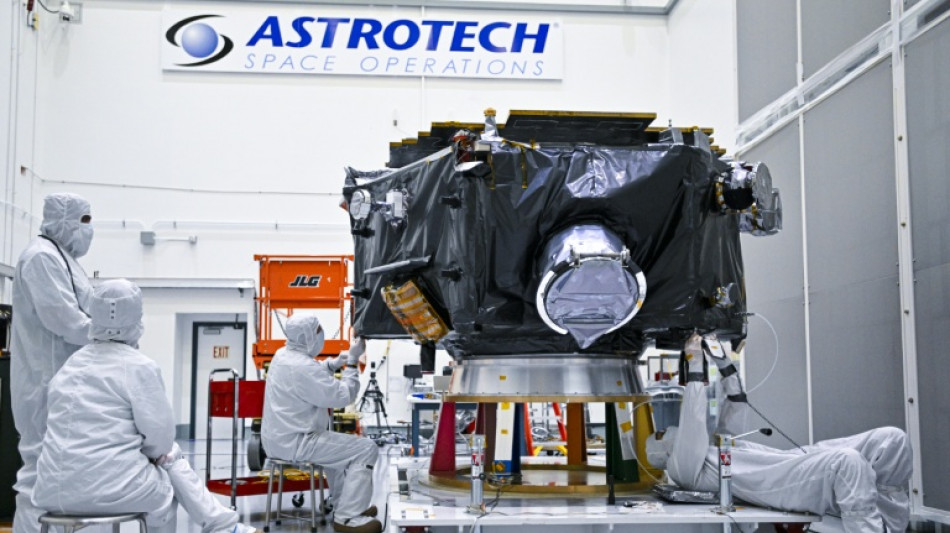
NASA launches mission to study space weather / Photo: © AFP

The United States launched three spacecraft on Wednesday in an effort to better monitor space weather such as solar storms, which can interfere with technology and power systems on Earth.

Change text size:

The three probes blasted off from Florida's Kennedy Space Center aboard a Falcon 9 rocket, built by the private company SpaceX.

Once in space, the probes will begin a long journey to reach the Lagrange 1 point -- a spot approximately 1.5 million kilometers (930,000 miles) from the Sun that offers a stable vantage point for observation.

The "Interstellar Mapping and Acceleration Probe" (IMAP) will use its instruments to study the Sun's high-energy particles and the protective magnetic bubble surrounding our solar system known as the heliosphere, data that can offer insight into space weather and cosmic radiation.

Solar storms are high-radiation events caused by flares on the Sun's surface, and are very difficult to predict.

They can impact activities on Earth, including aviation, mobile communications and power grids -- and potentially endanger astronauts and satellites in space.

The Space Weather Follow-on (SWFO-L1) spacecraft, operated by the National Oceanic and Atmospheric Administration (NOAA), aims to detect the weather patterns in advance.

"It can't stop an incoming threat, but it can give us time to prepare," said Irene Parker of NOAA.

With notice, authorities could shelter astronauts, warn aircraft pilots of forthcoming disruptions of GPS systems and adapt power grids in anticipation.

And the Carruthers Geocorona Observatory, the third passenger on the rocket, will study the Earth's exosphere in a bid to better understand how space weather affects it.

S.M.Riley--TNT

Featured

Mysterious world beyond Pluto may have an atmosphere: astronomers

A tiny, little-known world beyond Pluto appears to have an atmosphere, Japanese astronomers said Monday, defying what had been thought possible for icy objects in our cosmic backyard.

Datavault AI and CyberCatch Announce Signing of Binding Letter of Intent for Datavault AI to Acquire CyberCatch to Accelerate AI-Driven, Quantum-Resistant Cyber Risk Mitigation Solutions

Strategic acquisition is anticipated to position Datavault AI to bring CyberCatch's AI-enabled cyber risk mitigation solution into Datavault AI's SanQtum-secured edge Graphics Processing Unit ecosystem, addressing a global information security market projected to reach $240 billion in 2026 (Gartner)CyberCatch's post-quantum cryptography conversion plan is also expected to position the combined company ahead of the AI-enabled "Q-Day" quantum-attack horizon, now compressed to as early as 2029 (Google)AI-enabled adversary attacks in 2025 rose 89% year-over-year while average eCrime breakout time fell to 29 minutes, a 65% increase in adversary speed compared to 2024, per CrowdStrike's 2026 Global Threat Report, and Google Quantum AI research has now compressed the timeline for cryptographically relevant quantum computing to as early as 2029.

Apple earnings beat forecasts on iPhone 17 demand

Apple on Thursday said it had its best start to the year ever when it came to earnings, with iPhone demand and digital service sales helping it beat expectations.

Musk grilled on AI profits at OpenAI trial

Elon Musk sparred with lawyers for a third day Thursday at his California trial against OpenAI, struggling to explain why his own for-profit AI empire differs from the one he is trying to take down.

Change text size: