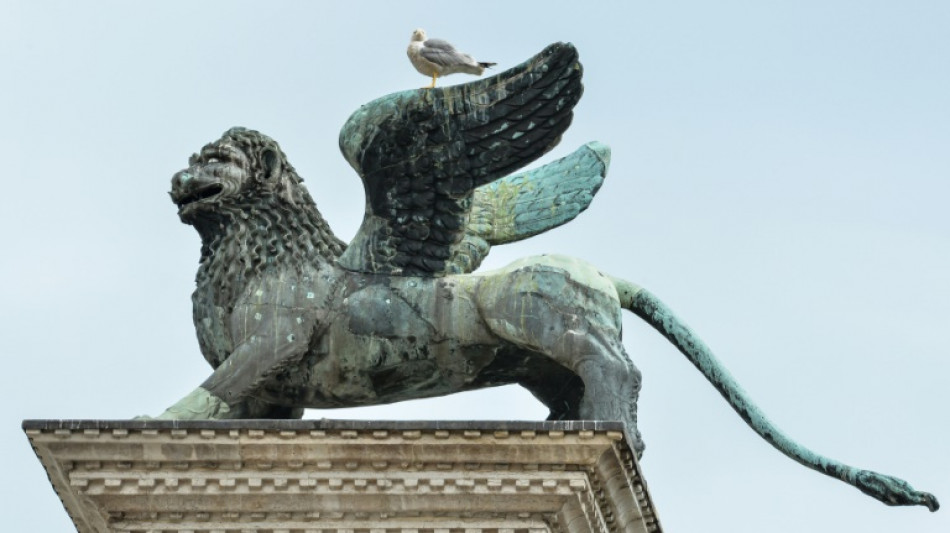
Made in China? The remarkable tale of Venice's iconic winged lion / Photo: © AFP/File
A winged lion sculpture that symbolises the Italian city of Venice was made in China and went on a remarkable journey that possibly involved explorer Marco Polo's father and the court of Mongol emperor Kublai Khan, researchers suggested Thursday.
Every year millions of people pass under the Lion of Venice, an ancient bronze sculpture which looks out on the Venetian Lagoon from the top of a column on the main square Piazza San Marco.
However much about this icon of the Venetian Republic remains shrouded in mystery.
It bears clear signs of having had a life before being installed near Saint Mark's Basilica and Doge's Palace.
Over the centuries its ears have been shortened, its wings have been changed -- the sculpture even once had horns that were shorn off at some point.
"We don't know when the sculpture arrived in Venice, where it was reworked, who did it, or when it was erected on the column where it is still visible today," Massimo Vidale, an archaeologist at the University of Padua and co-author of a new study, said in a statement.
The only historical document that mentions the sculpture dates back to 1293, when it was already damaged and in need of repair.
The violet granite of the sculpture's column -- which could have been looted from the sacking of the ancient city Constantinople, modern-day Istanbul -- likely arrived in Venice shortly before 1261, the study said.
Hoping to shed light on the winged lion's mysterious past, a team of Italian researchers analysed lead isotopes in samples taken during a 1990 restoration.
The sculpture's copper ore was mined in the Yangtze River basin in China, the analysis revealed.
That is dramatically farther east than previous theories about where the sculpture came from, which include a 12th-century Venetian foundry, or somewhere in Anatolia or Syria during the Hellenistic period.
- A 'somewhat brazen idea' -
And it may not actually be a lion at all.
It more closely resembles tomb guardian sculptures called "zhenmushou" from China's Tang Dynasty (618–907 AD), the researchers said.
"These hybrid creatures share leonine muzzles, flaming manes, horns and raised wings attached to the shoulders, pointed upraised ears and, sometimes, partially humanised facial features," according to the study in the journal Antiquity.
Although made from different material, the zhenmushou sculptures that are still around look very similar to the Lion of Venice -- particularly its "bulbous nose", the study added.
So how did this tomb guardian make it all the way to Venice?
Perhaps in the luggage of Niccolo and Maffeo Polo, the father and uncle of the famed Venetian explorer Marco Polo, the researchers theorised.
Around 1265, the travelling merchants visited the court of the Mongol emperor Kublai Khan in Khanbalik -- modern-day Beijing.
They could have stumbled on the sculpture there, the researchers said.
Just years earlier the Republic of Venice had adopted the lion as its symbol, and "the Polos may have had the somewhat brazen idea of readapting the sculpture into a plausible (when viewed from afar) Winged Lion," the study said.
They could have then sent the sculpture to Venice along the trade route known as the Silk Road.
That was not the end of its travels. After French general Napoleon Bonaparte defeated the Venetian Republic in 1797, he moved the winged lion to Paris.
Broken into pieces, it did not return to Venice until 1815.
W.Baxter--TNT