The National Times - Scientists unearth 'cute' but fearsome ancient whale

Scientists unearth 'cute' but fearsome ancient whale


Scientists unearth 'cute' but fearsome ancient whale
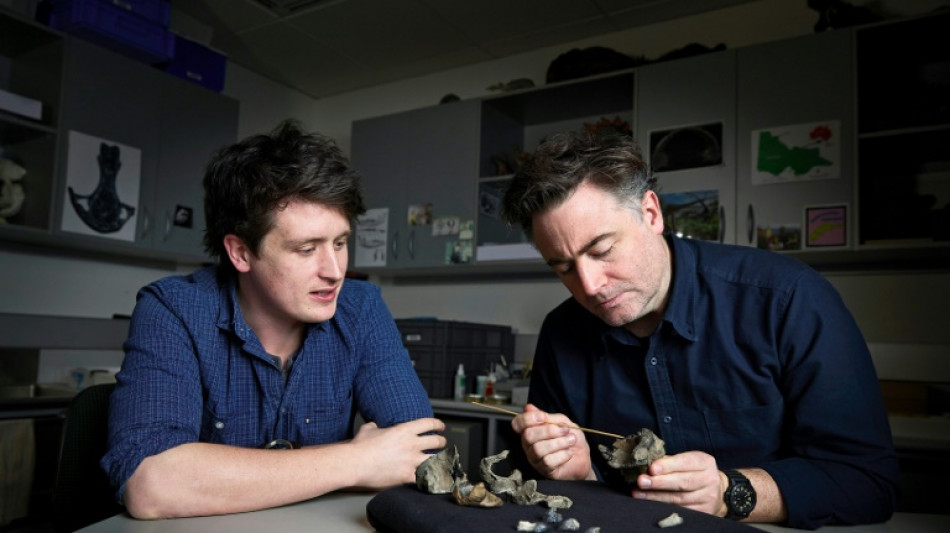
Scientists unearth 'cute' but fearsome ancient whale / Photo: © MUSEUMS VICTORIA/AFP

Australian scientists have discovered a razor-toothed whale that prowled the seas 26 million years ago, saying Wednesday the species was "deceptively cute" but a fearsome predator.

Change text size:

Museums Victoria pieced together the species from an unusually well-preserved skull fossil found on Victoria's Surf Coast in 2019.

Scientists discovered a "fast, sharp-toothed predator" that would have been about the size of a dolphin.

"It's essentially a little whale with big eyes and a mouth full of sharp, slicing teeth," said researcher Ruairidh Duncan.

"Imagine the shark-like version of a baleen whale -- small and deceptively cute, but definitely not harmless."

The skull belonged to a group of prehistoric whales known as the mammalodontids, distant smaller relatives of today's filter-feeding whales.

It is the fourth mammalodontid species ever discovered, Museums Victoria said.

"This fossil opens a window into how ancient whales grew and changed, and how evolution shaped their bodies as they adapted to life in the sea," said palaeontologist Erich Fitzgerald, who co-authored the study.

Victoria's Surf Coast lies on the Jan Juc Formation -- a geological feature dating to the Oligocene epoch between 23 and 30 million years ago.

A string of rare fossils have been unearthed along the scenic stretch of beach, a renowned site for the study of early whale evolution.

"This region was once a cradle for some of the most unusual whales in history, and we're only just beginning to uncover their stories," said Fitzgerald.

"We're entering a new phase of discovery.

"This region is rewriting the story of how whales came to rule the oceans, with some surprising plot twists."

The species was named Janjucetus dullardi, a nod to local Ross Dullard who stumbled across the skull while strolling the beach in 2019.

It was described in the peer-reviewed Zoological Journal of the Linnean Society.

N.Roberts--TNT

Featured

Transoft Solutions Acquires CADaptor Solutions

Transoft Solutions Expands Temporary Traffic Management Portfolio With Latest Acquisition

Digi Power X Signs AI Colocation Agreement with Leading AI Compute Company for 40 MW Data Center in Columbiana, Alabama

MIAMI, FL / ACCESS Newswire / May 5, 2026 / Digi Power X Inc. (Nasdaq:DGXX)(Cboe Canada:DGX) (the "Company" or "Digi Power X"), an AI data center infrastructure operator, today announced the execution of a Master Services Agreement (the "Agreement") with Cerebras Systems (the "Customer") for the colocation of a purpose-built, 40 megawatt ("MW") AI data center campus located in Columbiana, Alabama (the "Facility").

Mysterious world beyond Pluto may have an atmosphere: astronomers

A tiny, little-known world beyond Pluto appears to have an atmosphere, Japanese astronomers said Monday, defying what had been thought possible for icy objects in our cosmic backyard.

Datavault AI and CyberCatch Announce Signing of Binding Letter of Intent for Datavault AI to Acquire CyberCatch to Accelerate AI-Driven, Quantum-Resistant Cyber Risk Mitigation Solutions

Strategic acquisition is anticipated to position Datavault AI to bring CyberCatch's AI-enabled cyber risk mitigation solution into Datavault AI's SanQtum-secured edge Graphics Processing Unit ecosystem, addressing a global information security market projected to reach $240 billion in 2026 (Gartner)CyberCatch's post-quantum cryptography conversion plan is also expected to position the combined company ahead of the AI-enabled "Q-Day" quantum-attack horizon, now compressed to as early as 2029 (Google)AI-enabled adversary attacks in 2025 rose 89% year-over-year while average eCrime breakout time fell to 29 minutes, a 65% increase in adversary speed compared to 2024, per CrowdStrike's 2026 Global Threat Report, and Google Quantum AI research has now compressed the timeline for cryptographically relevant quantum computing to as early as 2029.

Change text size: