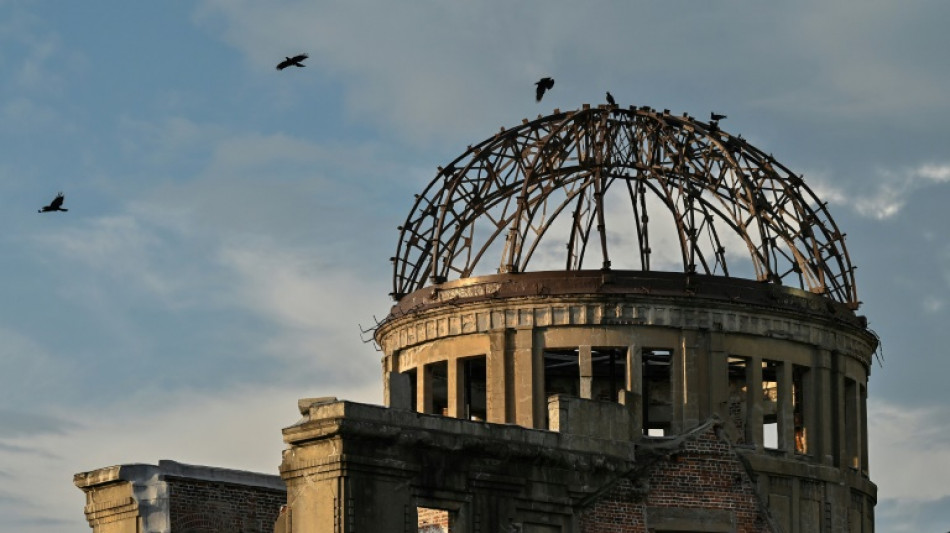
Hiroshima marks 80 years as US-Russia nuclear tensions rise / Photo: © AFP
Japan marks 80 years since the atomic bombing of Hiroshima on Wednesday with a ceremony reminding the world of the horrors unleashed, as sabre-rattling between the United States and Russia keeps the nuclear "Doomsday Clock" close to midnight.
A silent prayer was due to be held at 8:15 am (2315 GMT), the moment when US aircraft Enola Gay dropped "Little Boy" over the western Japanese city on August 6, 1945.
The final death toll would hit around 140,000 people, killed not just by the colossal blast and the ball of fire, but also later by the radiation.
Three days after "Little Boy", on August 9, another atomic bomb killed 74,000 people in Nagasaki. Imperial Japan surrendered on August 15, bringing an end to World War II.
Today, Hiroshima is a thriving metropolis of 1.2 million people, but the ruins of a domed building stand in the city centre as a stark reminder.
Wednesday's ceremony was set to include a record of around 120 countries and regions including, for the first time, Taiwanese and Palestinian representatives.
The United States -- which has never formally apologised for the bombings -- will be represented by its ambassador to Japan. Absent will be Russia and China, organisers said Monday.
Nihon Hidankyo, the grassroots organisation that last year won the Nobel Peace Prize, will represent the dwindling number of survivors, known as hibakusha.
As of March, there are 99,130 hibakusha, according to the Japanese health ministry, with the average age of 86.
"I want foreign envoys to visit the peace memorial museum and understand what happened," the group's co-chair Toshiyuki Mimaki told local media ahead of the commemorations.
- Younger generation -
The attacks remain the only time atomic bombs have been used in wartime.
Hiroshima Mayor Kazumi Matsui is expected at the ceremony to urge attendees to "never give up" on achieving a nuclear-free world.
Kunihiko Sakuma, 80, who survived the blasts as a baby, told AFP he was hopeful.
"I think the global trend of seeking a nuclear-free world will continue," he said.
"The younger generation is working hard for that end," he said ahead of the ceremony.
But in January, the Bulletin of the Atomic Scientists' "Doomsday Clock" shifted to 89 seconds to midnight, the closest in its 78-year history.
The clock symbolising humanity's distance from destruction was last moved to 90 seconds to midnight over Russia's invasion of Ukraine in 2022.
Russia and the United States account for around 90 percent of the world's over 12,000 warheads, according to the Stockholm International Peace Research Institute (SIPRI).
SIPRI warned in June that "a dangerous new nuclear arms race is emerging at a time when arms control regimes are severely weakened," with nearly all of the nine nuclear-armed states modernising their arsenals.
Earlier this month, US President Donald Trump said that he had ordered the deployment of two nuclear submarines following an online spat with former Russian president Dmitry Medvedev.
"It seems to me that he does not fully understand the reality of the atomic bombings, which, if used, take the lives of many innocent citizens, regardless of whether they were friend or foe, and threaten the survival of the human race," Matsui said at the time.
H.Davies--TNT