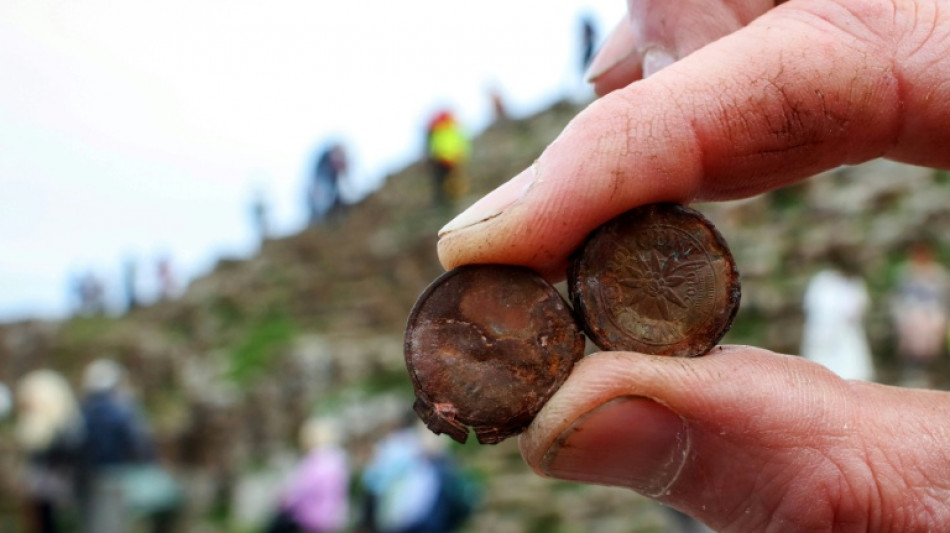
Tourist coins pose giant problem at N. Ireland's famous causeway site / Photo: © AFP
Northern Ireland's Giant Causeway draws close to one million visitors a year but their habit of wedging tiny coins in cracks between the rocks -- to bring love or luck -- is damaging the world-famous wonder.
Now authorities are urging tourists to keep their coins in their pockets to preserve the spectacular landscape.
Some 40,000 columns mark the causeway, Northern Ireland's first UNESCO World Heritage Site.
Geologists say the natural phenomenon was created by an outpouring of basalt lava 60 million years ago.
Legend has it that the causeway was formed by Irish giant Finn McCool.
In recent decades, visitors have pushed thousands of coins into fissures in the rocks.
The gesture is "a token of love or luck", according to Cliff Henry, the causeway's nature engagement officer.
But the coins rapidly corrode and expand, causing the basalt to flake and leaving "unsightly" rust-coloured streaks, Henry told AFP.
He pointed to streaks on a rock and gingerly prised out a US cent with a set of keys.
"We get a lot of euros and dollar cents. But coins from literally all over the world -- any currency you can think of, pretty much -- we have had it here," he said.
A report by the British Geological Survey in 2021 revealed that the coins were "doing some serious damage" and something had to be done about it, he noted.
Signs are now in place around the site appealing to tourists to "leave no trace".
- 'Distressed' -
"Once some visitors see other people have done it, they feel that they need to add to it," causeway tour guide Joan Kennedy told AFP.
She and her colleagues now gently but firmly tell tourists to desist.
At the exit from the causeway, a US couple said they were "distressed" to hear of the damage the metal caused.
"Our guide mentioned as we came up that people had been putting coins into the stones. It's really terrible to hear that," said Robert Lewis, a 75-year-old from Florida.
"It's kind of like damaging any kind of nature when you are doing something like that, putting something foreign into nature. It's not good," said his wife, Geri, 70.
As part of a £30,000 ($40,000) conservation project, stone masons recently removed as many coins as they could -- without causing further damage -- from 10 test sites around the causeway.
Henry said the trial was successful and is to be expanded across the causeway.
"If we can get all those coins removed to start with that will help the situation and hopefully no more coins will be put in," he said.
"If visitors see fewer coins in the stones and hear appeals to stop the damaging practice, the problem can maybe be solved.
"We know that visitors love and cherish the Giant's Causeway,and many form deep personal connections to it, so we want this natural wonder to remain special for future generations."
R.Evans--TNT