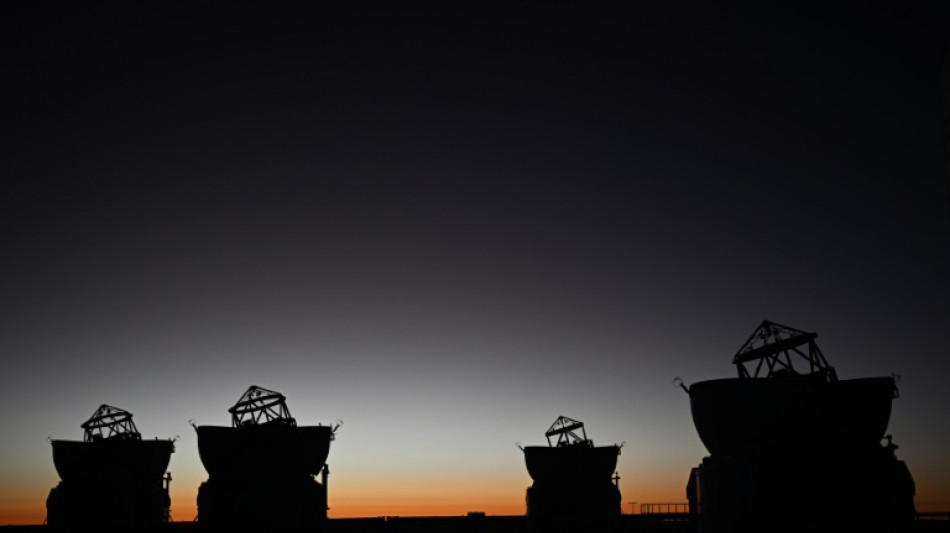
European star-gazing agency says Chile green power plant will ruin its view / Photo: © AFP
Europe's ESO astrophysics agency said Monday that a giant green energy project billed for Chile's Atacama desert -- home to the world's darkest skies -- will spoil its view of the stars and threaten its science mission.
AES Andes, a subsidiary of US energy company AES Corporation, has submitted proposals for the construction of a 3,000-hectare (7,400-acre) project in the desert to generate solar and wind energy and green hydrogen.
The $10 billion Inna project, part of Chile's plans to become carbon neutral, is still subject to an environmental impact assessment.
On Monday, the European Southern Observatory (ESO) said its own technical analysis has revealed "alarming" consequences for the telescopes that form part of its Paranal Observatory.
"The impact is going to be devastating, irreversible, and cannot be mitigated if the project remains where they intend" to build it, ESO Chile representative Itziar de Gregorio-Monsalvo told reporters in Santiago.
The telescopes examine faraway Earth-like planets and galaxies to create a better understanding of our universe, "and even monitor asteroids that could cause damage to our planet," according to the ESO.
The analysis found Inna would increase light pollution above the Very Large Telescope (VLT) "by at least 35 percent."
The VLT started operating in 1999 with an ESO investment of 330 million euros (about $360 million), according to the agency.
At its stadium-sized Extremely Large Telescope -- due to start scientific observations in 2029 with a budget of 1.45 billion euros -- light pollution would increase by five percent -- "a level of interference incompatible with the conditions required for world-class astronomical observations," said the ESO.
There will also be harms from atmospheric turbulence, ground vibrations and dust contamination, an ESO statement said.
AES Andes has said the Inna project would conform to the "highest norms in terms of lighting," including a Chilean rule to protect astronomy sites from skyglow.
It has also said the project would be further away from the telescopes than stated by the ESO.
The agency said it would submit a full technical report to Chilean authorities this month to be considered in the environmental impact assessment.
P.Sinclair--TNT