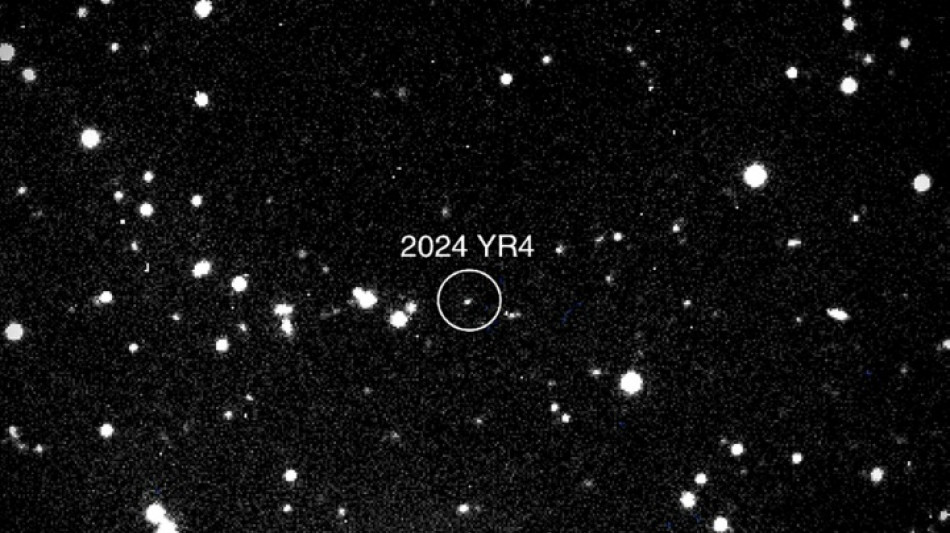
A 'city-killer' asteroid might hit Earth -- how worried should we be? / Photo: © NASA/Magdalena Ridge 2.4m telescope/New Mexico Institute of Technology/Ryan/AFP
A colossal explosion in the sky, unleashing energy hundreds of times greater than the Hiroshima bomb. A blinding flash nearly as bright as the Sun. Shockwaves powerful enough to flatten everything for miles.
It may sound apocalyptic, but a newly detected asteroid nearly the size of a football field now has a greater than one percent chance of colliding with Earth in about eight years.
Such an impact has the potential for city-level devastation, depending on where it strikes.
Scientists aren't panicking yet, but they are watching closely.
"At this point, it's 'Let's pay a lot of attention, let's get as many assets as we can observing it,'" Bruce Betts, chief scientist of The Planetary Society, told AFP.
- Rare finding -
Dubbed 2024 YR4, the asteroid was first spotted on December 27, 2024, by the El Sauce Observatory in Chile. Based on its brightness, astronomers estimate it is between 130 and 300 feet (40–90 meters) wide.
By New Year's Eve, it had landed on the desk of Kelly Fast, acting planetary defense officer at US space agency NASA, as an object of concern.
"You get observations, they drop off again. This one looked like it had the potential to stick around," she told AFP.
The risk assessment kept climbing, and on January 29, the International Asteroid Warning Network (IAWN), a global planetary defense collaboration,issued a memo.
According to the latest calculations from NASA's Jet Propulsion Laboratory, there is a 1.6 percent chance the asteroid will strike Earth on December 22, 2032.
If it does hit, possible impact sites include over the eastern Pacific Ocean, northern South America, the Atlantic Ocean, Africa, the Arabian Sea, and South Asia, the IAWN memo states.
2024 YR4 follows a highly elliptical, four-year orbit, swinging through the inner planets before shooting past Mars and out toward Jupiter.
For now, it's zooming away from Earth -- its next close pass won't come until 2028.
"The odds are very good that not only will this not hit Earth, but at some point in the next months to few years, that probability will go to zero," said Betts.
A similar scenario unfolded in 2004 with Apophis, an asteroid initially projected to have a 2.7 percent chance of striking Earth in 2029. Further observations ruled out an impact.
- Destructive potential -
The most infamous asteroid impact occurred 66 million years ago, when a six-mile-wide space rock triggered a global winter, wiping out the dinosaurs and 75 percent of all species.
By contrast, 2024 YR4 falls into the "city killer" category.
"If you put it over Paris or London or New York, you basically wipe out the whole city and some of the environs," said Betts.
The best modern comparison is the 1908 Tunguska Event, when an asteroid or comet fragment measuring 30-50 meters exploded over Siberia, flattening 80 million trees across 770 square miles (2,000 square kilometers).
Like that impactor, 2024 YR4 would be expected to blow up in the sky, rather than leaving a crater on the ground.
"We can calculate the energy... using the mass and the speed," said Andrew Rivkin, a planetary astronomer at Johns Hopkins Applied Physics Laboratory.
For 2024 YR4, the explosion from an airburst would equal around eight megatons of TNT -- more than 500 times the power of the Hiroshima bomb.
If it explodes over the ocean, the impact would be less concerning, unless it happens near a coastline triggering a tsunami.
- We can stop it -
The good news, experts stress, is that we have plenty of time to prepare.
Rivkin led the investigation for NASA's 2022 DART mission, which successfully nudged an asteroid off its course using a spacecraft -- a strategy known as a "kinetic impactor."
The target asteroid posed no threat to Earth, making it an ideal test subject.
"I don't see why it wouldn't work" again, he said. The bigger question is whether major nations would fund such a mission if their own territory wasn't under threat.
Other, more experimental ideas exist.
Lasers could vaporize part of the asteroid to create a thrust effect, pushing it off course. A "gravity tractor," a large spacecraft that slowly tugs the asteroid away using its own gravitational pull, has also been theorized.
If all else fails, the long warning time means authorities could evacuate the impact zone.
"Nobody should be scared about this," said Fast. "We can find these things, make these predictions and have the ability to plan."
F.Adams--TNT