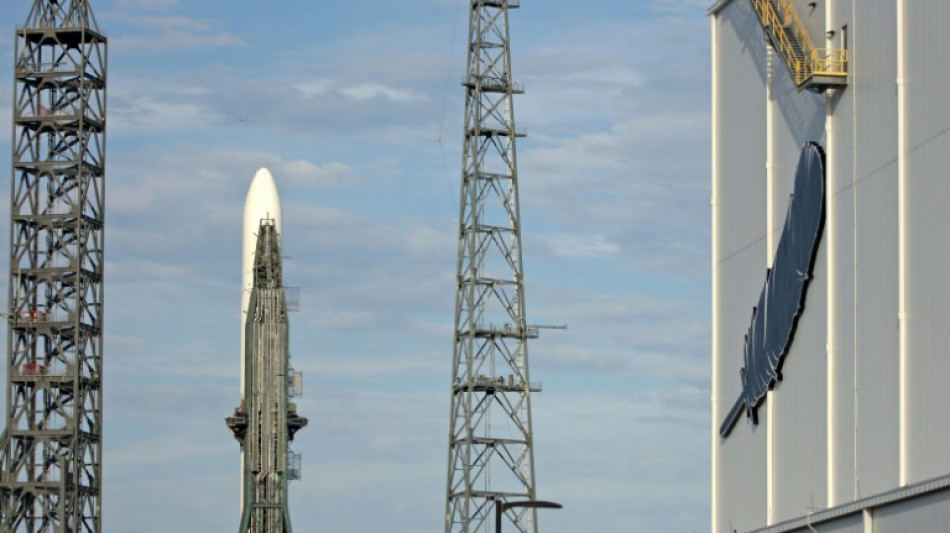
Blue Origin pushes back first launch of giant New Glenn rocket / Photo: © AFP
Jeff Bezos's Blue Origin will have to wait a little longer for the long-anticipated maiden orbital flight of its brand-new rocket after a launch attempt dragged on for hours before being canceled due to unspecified technical issues.
The towering 320-foot (98-meter) rocket, dubbed New Glenn in honor of legendary astronaut John Glenn, was scheduled to lift off from Cape Canaveral Space Force Station during a three-hour window starting at 1:00 am (0600 GMT) Monday.
But the countdown repeatedly stalled as teams scrambled to resolve anomalies, before the mission was officially "scrubbed" around 3:10 am.
"We are standing down today's launch attempt to troubleshoot a vehicle subsystem issue that will take us beyond our launch window," said Ariane Cornell, a Blue Origin executive, during a livestream watched by hundreds of thousands of viewers.
Cornell added: "We are reviewing opportunities for our next launch attempt."
With the mission, dubbed NG-1, billionaire Amazon founder Bezos is taking aim at the only man in the world wealthier than him: Elon Musk, whose company SpaceX dominates the orbital launch market through its prolific Falcon 9 rockets, vital for the commercial sector, the Pentagon and NASA.
Bezos, who celebrated his 61st birthday on Sunday, watched events unfold from the nearby launch control room. Musk, for his part, wished Blue Origin "Good luck!" on X.
"SpaceX has for the past several years been pretty much the only game in town, and so having a competitor... this is great," G. Scott Hubbard, a retired senior NASA official, told AFP, expecting the competition to drive down costs.
SpaceX, meanwhile, is planning the next orbital test of Starship -- its gargantuan new-generation rocket -- this week, upping the high-stakes rivalry.
- Landing attempt -
When New Glenn does fly, Blue Origin will attempt to land the first-stage booster on a drone ship named Jacklyn, in honor of Bezos's mother, stationed about 620 miles (1,000 kilometers) downrange in the Atlantic Ocean.
Though SpaceX has long made such landings a near-routine spectacle, this will be Blue Origin's first shot at a touchdown on the high seas.
Meanwhile, the rocket's upper stage will fire its engines toward Earth orbit, reaching a maximum altitude of roughly 12,000 miles above the surface.
A Defense Department-funded prototype of an advanced spaceship called Blue Ring, which could one day fare the solar system, will remain aboard for the roughly six-hour test flight.
Blue Origin has experience landing its New Shepard rockets -- used for suborbital tourism -- but they are five times smaller and land on terra firma rather than a ship at sea.
Physically, New Glenn dwarfs the 230-foot Falcon 9 and is designed for heavier payloads.
It slots between Falcon 9 and its big sibling, Falcon Heavy, in terms of mass capacity but holds an edge with its wider payload fairing, capable of carrying the equivalent of 20 moving trucks.
- Slow v fast development -
Blue Origin has already secured a NASA contract to launch two Mars probes aboard New Glenn. The rocket will also support the deployment of Project Kuiper, a satellite internet constellation designed to compete with Starlink.
For now, however, SpaceX maintains a commanding lead, while other rivals -- United Launch Alliance, Arianespace, and Rocket Lab -- trail far behind.
Like Musk, Bezos has a lifelong passion for space. But whereas Musk dreams of colonizing Mars, Bezos envisions shifting heavy industry off-planet onto floating space platforms in order to preserve Earth, "humanity's blue origin."
He founded Blue Origin in 2000 -- two years before Musk created SpaceX -- but has adopted a more cautious pace, in contrast to his rival's "fail fast, learn fast" philosophy.
If New Glenn succeeds, it will provide the US government "dissimilar redundancy" -- valuable backup if one system fails, said Scott Pace, a space policy analyst at George Washington University.
I.Paterson--TNT