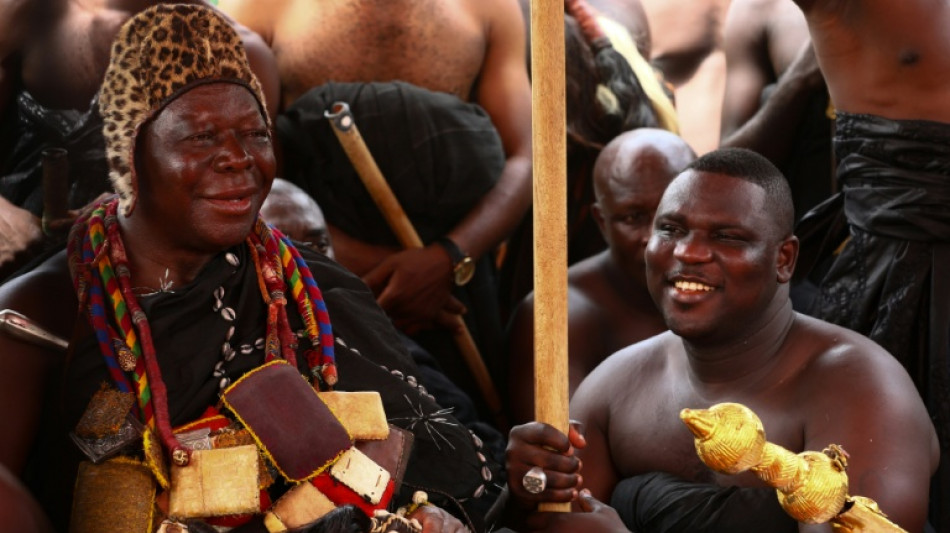
Historic gold regalia returned to Ghana's king / Photo: © AFP
Ghana's Asante king, Otumfuo Osei Tutu II, will receive 28 historic gold ornaments and regalia this weekend, in the latest major restoration of cultural treasures to the West African country.
The objects, dating to the 19th century, are symbols of governance, chiefship and royal heritage.
Originally crafted by Asante court artisans, they include swords, linguist staffs, palace security locks, rings, necklaces and gold weights.
The artefacts were authenticated by historian and associate director of the Manhyia Palace Museum, Ivor Agyeman-Duah.
"This is a significant cultural moment for Ghana and Africa," he said.
Speaking to AFP, he described the regalia as "masterpieces of gold smithery reflecting the sophistication of Asante court governance".
The presentation will take place at a mini-durbar at the Manhyia Palace in Kumasi, coinciding with the 100th anniversary of the return from exile of the king's grand-uncle, Nana Agyeman Prempeh I.
The event will also honour the visiting president of Seychelles, Wavel Ramkalawan, according to a statement from the palace.
Agyeman-Duah said the restitution follows a direct appeal that the Asante king -- the Asantehene -- made earlier this year to AngloGold Ashanti, a South African mining company, to hand back the artefacts.
- Stolen goods -
The objects had been part of the company's Gold of Africa Museum in Cape Town, South Africa, before being transferred to the Javett Art Centre at the University of Pretoria.
Their return to Kumasi was approved three weeks ago by the Reserve Bank of South Africa, the statement added.
The objects will be housed in a new contemporary gallery recently added to the Manhyia Palace Museum.
This restitution brings the total number of cultural objects returned to the Asante Palace this year to 67, the largest repatriation of artefacts in Africa in recent years.
Earlier this year, seven items looted during the 1874 Anglo-Asante War were returned by the Fowler Museum at UCLA in California.
A further 32 were restituted from the British Museum and the Victoria and Albert Museum in London.
An AngloGold Ashanti delegation will attend the ceremony in Kumasi.
Neighbouring Nigeria is also negotiating the return of thousands of 16th- to 18th-century objects looted from the ancient kingdom of Benin and held by museums and art collectors across the United States and Europe.
And, two years ago, Benin received two dozen treasures and artworks stolen in 1892 by French colonial forces.
S.Collins--TNT