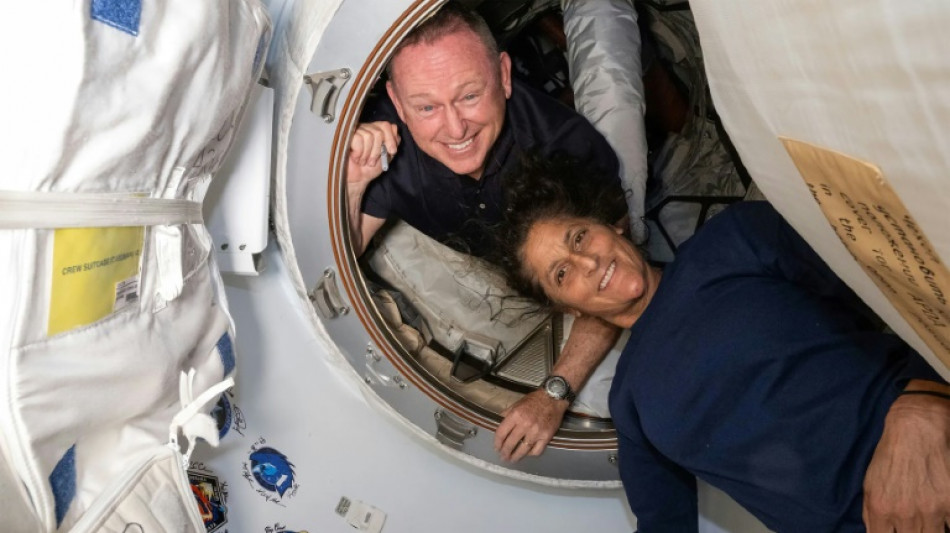
Astronauts stuck on ISS 'confident' Starliner will bring them home / Photo: © NASA/AFP/File
A pair of NASA astronauts left stranded on the International Space Station without a clear departure date expressed confidence Wednesday that their Boeing Starliner spaceship would soon bring them home.
Butch Wilmore and Suni Williams blasted off on June 5 following years of delays and safety scares affecting Starliner, as well as two aborted launch attempts that came as the two were strapped in and ready to go.
They docked the following day for what was meant to be roughly a week-long stay, but their return has been pushed back because of thruster malfunctions and helium leaks that came to light during the journey.
Asked during a live press call from the orbital outpost whether they still had faith in the Starliner team and the spaceship, mission commander Wilmore replied "We're absolutely confident."
"I have a real good feeling in my heart that the spacecraft will bring us home, no problem," added Williams.
She said they were continuing to enjoy their time aboard the ISS, performing tasks like changing out the pump on a machine that processes urine back into drinking water, and carrying out science experiments such as gene sequencing in the microgravity environment.
They have also tested Starliner as a "safe haven" vehicle in case of problems aboard the station, and checked out how its life support performs when four people are inside.
Before Wilmore and Williams can come home, however, ground teams need to run more testing to better understand the root causes of some of the technical issues Starliner experienced.
It was known there was one helium leak affecting the spaceship before the launch, but more leaks emerged during the flight. While non-combustible, helium provides pressure to the propulsion system.
Separately, some of Starliner's thrusters that provide fine maneuvering initially failed to kick in, delaying docking. Engineers are not sure why the craft's computer "deselected" these thrusters, though they were able to restart most of them.
The crew insisted Starliner could fly home in case there was an emergency, since the problems affected only the fine maneuvering thrusters and not those responsible for the deorbit burn that would bring the spaceship back into the atmosphere.
Teething issues with new spaceships aren't uncommon.
But the Starliner program has suffered from comparisons to SpaceX's Crew Dragon. Both companies were awarded multi-billion-dollar contracts in 2014 to provide the US space agency with rides to the ISS, with SpaceX succeeding in 2020 and carrying dozens of people since.
G.Morris--TNT