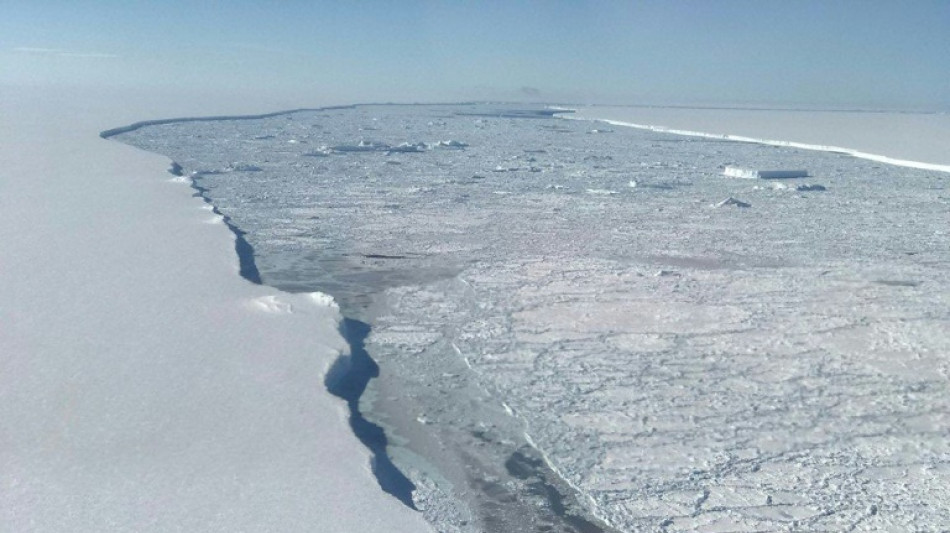
Monster iceberg released 'billions of tonnes' of fresh water into ocean
A giant iceberg that detached from Antarctica in 2017 released the equivalent of 61 million Olympic-sized swimming pools of fresh water as it melted, according to research published Thursday, raising questions over the impact on the marine ecosystem.
The monstrous iceberg was twice the size of Luxembourg when it separated from the Larsen ice shelf, which has warmed faster than any other part of Earth's southernmost continent.
At 5,719 square kilometres (2,200 square miles) it was the biggest iceberg on Earth when it formed and the sixth-largest on record, according to the British Antarctic Survey.
For two years, the trillion-tonne giant known as A-68, drifted close to home in the cold waters of the Weddell Sea before travelling northwards and menacing the British island of South Georgia, some 4,000 kilometres (2,500 miles) from its starting point.
The iceberg, by then known as A-68a after a piece snapped off, came dangerously close to the island in late 2020, raising fears that it would become stuck on the seabed, block ocean currents and obstruct the passage of thousands of penguins and seals.
But the new study found that while it did briefly graze the seabed, the iceberg melted quickly once in the warmer region around South Georgia and had already lost a significant amount of its bulk by the time it reached shallower waters.
Researchers who tracked its journey via satellites calculated that from late 2020 until it melted away in 2021, A-68 released an estimated total of 152 billion tonnes of nutrient-rich fresh water into the sea.
That is equivalent to 20 times the water in Scotland's Loch Ness, or 61 million Olympic-sized swimming pools, said the BAS in a press release, adding it was "a disturbance that could have a profound impact on the island's marine habitat".
"This is a huge amount of melt water," said Anne Braakmann-Folgmann, a researcher at the Centre for Polar Observation and Modelling (CPOM), who led the research published in the journal Remote Sensing of Environment.
"The next thing we want to learn is whether it had a positive or negative impact on the ecosystem" around South Georgia, she said.
- 'Classic' route -
Researchers said the cold fresh meltwater and nutrients released as icebergs melt can influence local ocean circulation and spark biological production.
Braakmann-Folgmann said A-68 had taken a "classic" route for icebergs in the region, adding that further research would look to learn more about how these icebergs are affecting the polar oceans.
Icebergs form when hunks of ice break off from ice shelves or glaciers and begin to float in open water.
Their formation is part of a natural process, although one which can be accelerated by warming air and ocean temperatures due to human-caused climate change.
Earth's average surface temperature has gone up by one degree Celsius since the 19th century, enough to increase the intensity of droughts, heat waves and tropical cyclones.
But the air over Antarctica has warmed more than twice that much.
Ice sheets atop Greenland and West Antarctic hold enough frozen water to lift oceans a dozen metres (40 feet), drowning cities and redrawing the planet's coastlines.
Icebergs are traditionally named after the Antarctic quadrant in which they were originally detected, then a sequential number.
If they break apart more letters are added to differentiate the fragments.
A.M.James--TNT