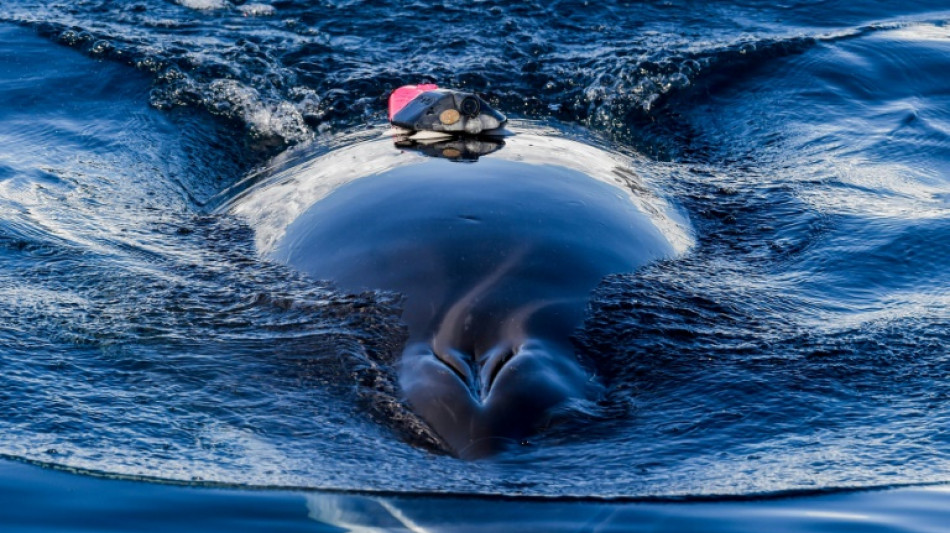
Norway study highlights whale excrement's role in ecosystem / Photo: © Stanford University/Goldbogen Laboratory/AFP/File
Minke whale excrement is "worth its weight in gold" as it plays an important role in fertilizing phytoplankton and thereby reducing the cetacean's carbon footprint, according to a Norwegian study.
For the first time, researchers from the Norwegian Institute for Marine Research have studied the concentration of nutrients in whale excrement before it is dissolved in seawater.
"It can sound disgusting, but for the ecosystem it's worth its weight in gold," researchers said in a statement Thursday.
"The idea is simply that the faeces fertilize the sea in the same way that cows and sheep do on land," they continued.
The researchers analysed the excrement of minke whales harpooned by whalers -- as Norway is one of few countries allowing the commercial hunting of these cetaceans.
The some 15,000 whales that migrate each summer to the Norwegian archipelago of Svalbard in the Arctic release some 600 tonnes of excrement on the surface of the water each day, at a rate of about 40 kilograms (88 pounds) per animal.
According to the study, the daily excrement releases about 10 tonnes of phosphorus and 7 tonnes of nitrogen into the oceans, nutrients that are essential for the growth of phytoplankton -- microscopic algae that absorb carbon dioxide through photosynthesis and convert it into oxygen.
The scientists concluded that the minke whale excrement contributed to between 0.2 and 4 percent of daily phytoplankton production in the Arctic Svalbard region.
"The real contribution of whales is probably higher because these estimates do not include urine, which is very rich in nitrogen," research leader Kjell Gundersen told AFP.
Each minke whale -- an animal weighing 40-50 tonnes as an adult that feeds by filtering large quantities of water -- releases "several hundred litres of urine" per day.
"If there are fewer whales, there is a risk that there will be less fertilisation of the ocean," Gundersen said.
"More phytoplankton production also means more CO2 is absorbed," he added.
"This is positive for the climate," he noted, "but we don't know the net balance of whales in terms of greenhouse gases" because cetaceans also emit methane when they breathe.
This question, which is still largely unexplored, will be the subject of a European study that will start in June and last four years.
P.Jones--TNT