The National Times - Small asteroid 'serendipitously' detected using James Webb telescope

Small asteroid 'serendipitously' detected using James Webb telescope


Small asteroid 'serendipitously' detected using James Webb telescope
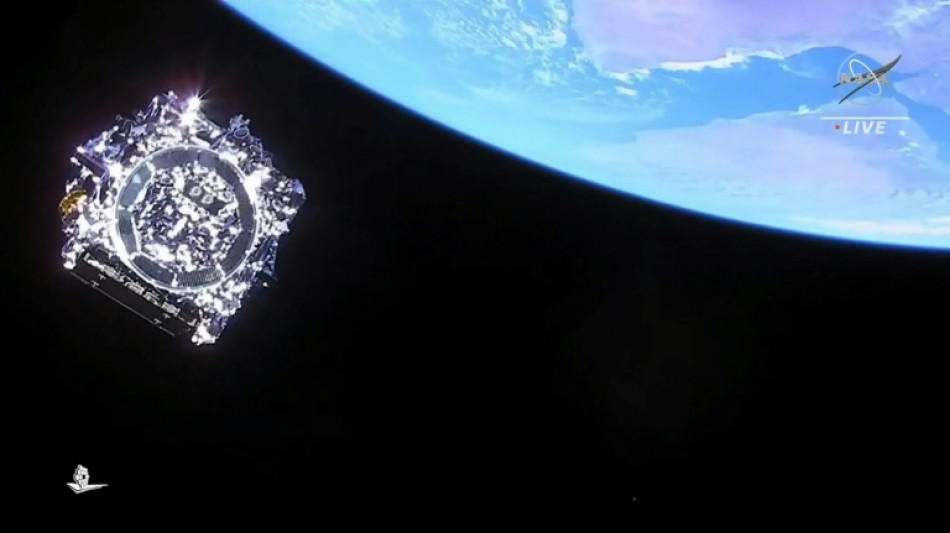
Small asteroid 'serendipitously' detected using James Webb telescope / Photo: © NASA TV/AFP/File

European astronomers using the James Webb Space Telescope have detected a previously unknown asteroid about the size of Rome's Colosseum in the main asteroid belt between Mars and Jupiter.

Change text size:

The asteroid measuring between 300 and 650 feet (100 to 200 meters) in length is the smallest object observed to date using the telescope, the US space agency NASA said Monday.

The European astronomers "serendipitously detected" the asteroid, NASA said in a statement, adding that more observations would be needed to better characterize its nature and properties.

"We -– completely unexpectedly -– detected a small asteroid," said Thomas Muller, an astronomer at the Max Planck Institute for Extraterrestrial Physics in Germany.

It was detected during calibration of the telescope's Mid-InfraRed Instrument (MIRI), which operates in mid-infrared wavelengths.

"Webb's incredible sensitivity made it possible to see this roughly 100-meter object at a distance of more than 100 million kilometers," Muller said.

Webb, which has been operational since July, is the most powerful space telescope ever built and has unleashed a raft of unprecedented data as well as stunning images.

One of the main goals for the $10 billion telescope is to study the life cycle of stars. Another main research focus is on exoplanets, planets outside Earth's solar system.

Webb was not designed to look for small objects such as the newly-discovered asteroid, but Muller said its discovery "suggests that many new objects will be detected with this instrument."

N.Johns--TNT

Featured

Ukrainian Drone Strikes Force Russian Firms to Seek Data Centers in Kazakhstan

Russian enterprises are accelerating plans to move computing operations abroad after Ukrainian drone strikes damaged data center facilities across six regions in October 2026. With domestic cloud capacity nearing full utilization, companies are turning to Kazakhstan and Belarus for backup infrastructure, while President Vladimir Putin has ordered private operators to reserve emergency government capacity.

NYT Connections Answers for Friday, November 13 (Game #1251)

The New York Times released its daily Connections puzzle, game #1251, on Friday, November 13. The word game challenges players to group words into four distinct categories of increasing difficulty, with today’s solution involving terms related to media attention and items that are towed.

Digi Power X Reports Q3 2026 Revenue Up 85% and AI Revenue Up Over 400% Compared to Q2

Contracted colocation at Columbiana represents approximately $402 million of Phase 1 contract value over the initial ten-year term and up to approximately $1.07 billion across both phases; Company ends quarter with $119.6 million in cash and digital currencies and no outstanding borrowings

NRC Approves Construction of Advanced Nuclear Reactors at Texas Petrochemical Site

The Nuclear Regulatory Commission has granted construction permits for four advanced nuclear reactors at a petrochemical facility on the Texas Gulf Coast. The project, a collaboration between chemical manufacturer Dow and nuclear developer X-energy, represents a significant milestone in the federal push to revitalize the U.S. nuclear sector through small modular reactor technology.

Change text size: