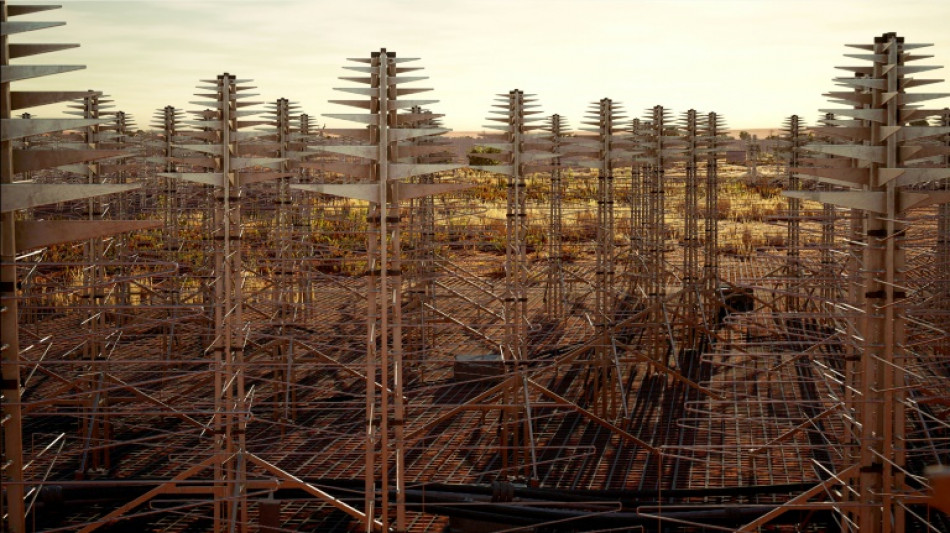
Australia starts building 'momentous' radio telescope / Photo: © Australia's Department of Industry, Science and Resources/AFP/File
Australia on Monday started building a vast network of antennas in the Outback, its section of what planners say will eventually become one of the most powerful radio telescopes in the world.
When complete, the antennas in Australia and a network of dishes in South Africa will form the Square Kilometre Array (SKA), a massive instrument that will aim to untangle mysteries about the creation of stars, galaxies and extraterrestrial life.
The idea for the telescope was first conceived in the early 1990s, but the project was plagued by delays, funding issues and diplomatic jockeying.
The SKA Observatory's Director-General Philip Diamond described the beginning of its construction as "momentous".
The telescope "will be one of humanity's biggest-ever scientific endeavours", he said.
Its name is based on the planners' original aim, a telescope that could observe a one-square-kilometre surface, but the current South African and Australian sections will have a combined collecting area of just under half that, according to the observatory.
Both countries have huge expanses of land in remote areas with little radio disturbance -- ideal for such telescopes.
More than 130,000 Christmas tree-shaped antennas are planned in Western Australia, to be built on the traditional lands of the Wajarri Aboriginal people.
They have dubbed the site "Inyarrimanha Ilgari Bundara", or "sharing sky and stars".
"We honour their willingness to share their skies and stars with us as we seek to find answers to some of the most fundamental science questions we face," said Diamond.
The South African site will feature nearly 200 dishes in the remote Karoo region, according to the organisation.
Comparison between radio telescopes is difficult as they operate in different frequencies, according to SKA's planners.
But they have said that the two sites will give SKA higher sensitivity over single-dish radio telescopes because its arrays are spread out, forming a much bigger "virtual dish".
The project will help in "charting the birth and death of galaxies, searching for new types of gravitational waves and expanding the boundaries of what we know about the universe", said telescope director Sarah Pearce.
Danny Price from the Curtin Institute of Radio Astronomy said the telescope would be extremely powerful.
"To put the sensitivity of the SKA into perspective, the SKA could detect a mobile phone in the pocket of an astronaut on Mars, 225 million kilometres away," he said.
The SKA Observatory, headquartered at Jodrell Bank in Britain, has said the telescope should start making scientific observations by the late 2020s.
The organisation has 14 members: Britain, Australia, South Africa, Canada, China, France, Germany, India, Italy, New Zealand, Spain, Sweden, Switzerland, and The Netherlands.
A.Little--TNT