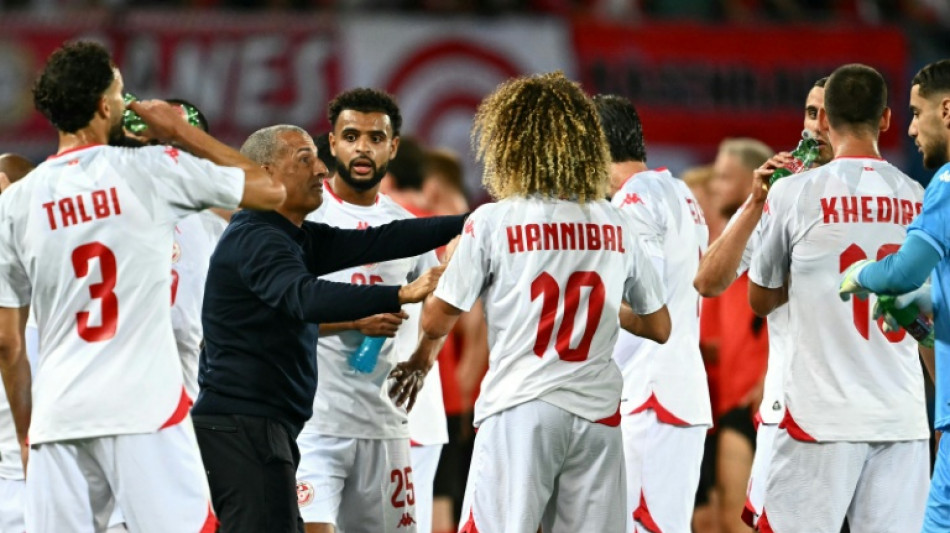
Greed or player health? 'Damaging' World Cup drinks breaks under spotlight / Photo: © AFP
Virgil van Dijk does not like them, fans have started booing them and the many critics say they are ruining the World Cup.
Hydration breaks last just a total of six minutes during a match, but they stand accused of fundamentally changing the nature of football at the sport's ultimate showpiece.
"Hydration breaks are a bit interesting," said Netherlands captain Van Dijk, whose side drew 2-2 with Japan in Texas on Sunday in an air-conditioned arena.
"I was watching almost all of the games up until today and every time going into a commercial is a bit... not really that I like it.
"I think for the neutral watchers on TV it's also not great."
Also Sunday, over at tournament co-host Mexico, spectators during Sweden's 5-1 thrashing of Tunisia in Monterrey made their disdain plain by booing loudly when the pause came in the first half.
Fans similarly jeered the break in Monday's game between Spain and Cape Verde in the air-conditioned arena in Atlanta.
The scheduled drinks breaks, not normally part of football, last three minutes each about midway through both halves of a game at the tournament in North America.
Football's world governing body FIFA says they are designed to protect player health and will be used at all World Cup games no matter where or what the weather.
So during the clash between the Netherlands and Japan, the game was halted even though the match was played in comfortable temperature-controlled conditions under a roof.
- 'Damaged for dollars' -
During the first hydration break at the stadium usually home to the Dallas Cowboys, the NFL team's cheerleaders were shown performing on the giant screen that hovers over the centre of the pitch.
For people in the United States watching on television, broadcasters take the chance to cut away from the game and show commercials.
In American sports, there is nothing unusual in that.
But some critics have accused FIFA of greed, feeding into a narrative that has consistently dogged the tournament and its decision-makers.
The world governing body denies those accusations.
"This is the year when the game of two halves became the game of four quarters," prominent British football writer Henry Winter said.
"And the greatest sport and event was damaged for fistfuls of dollars."
In a warning that will send a chill down the spines of traditionalists, Winter warned that the stoppages -- and the chance for a money-spinning ad break -- could one day be rolled out everywhere.
In England, the BBC and ITV show World Cup matches but do not cut away from games during the stoppages.
"It's important that there is resistance to this from all over," he said.
"Because if we tolerate this, our TV games could be next."
- Momentum shift -
And then there is the effect on the natural flow of matches.
It might be just a coincidence, but several games have seen a noticeable shift in momentum from one team to the other immediately after a hydration break.
Because while the players are drinking, coaches understandably use it as a chance to change tactics or give out instructions if the game is not going their way.
Debutants Curacao levelled for 1-1 after 21 minutes against the mighty Germany on Sunday in Houston, another game played under a roof.
Then came the pause, and with it went any Curacao momentum, the Germans running out 7-1 winners.
Not everyone is against the drinks breaks, however, with Spain coach Luis de la Fuente saying player welfare was paramount.
"It is difficult to sustain that level of physical exertion for long periods and I believe those breaks offer a brief respite to recharge and continue competing well," he said.
But he also noted that, while some World Cup cities are experiencing fierce temperatures, it is not true across all venues, including some outside ones.
For example in Los Angeles this week temperatures are forecast to be about 15-28C.
Van Dijk said there should be flexibility.
"If it's really hot, obviously it would be good to put them (breaks) in," said the Liverpool defender.
"But I think you have to look at it in every game separately in my opinion."
J.Sharp--TNT