The National Times - Chile president visits flashpoint region claimed by Indigenous groups

Chile president visits flashpoint region claimed by Indigenous groups


Chile president visits flashpoint region claimed by Indigenous groups
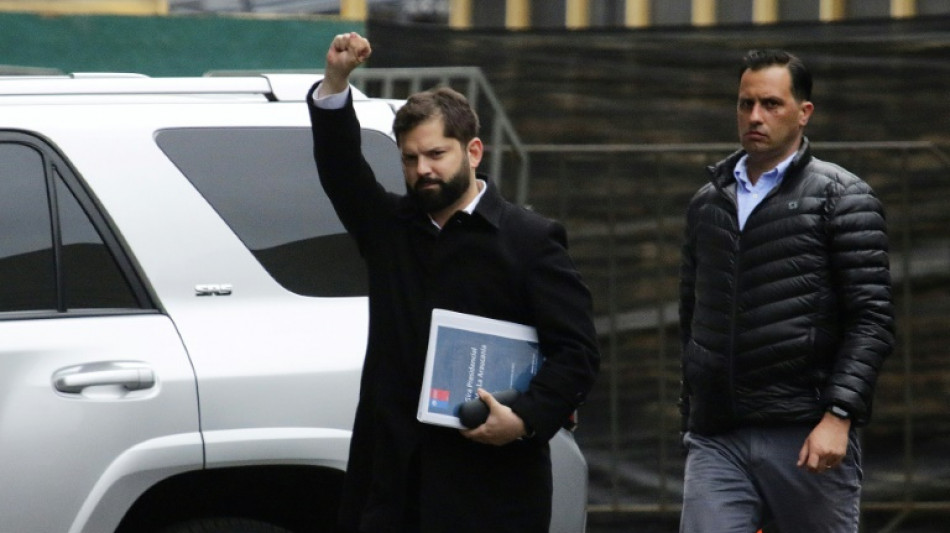
Chile president visits flashpoint region claimed by Indigenous groups / Photo: © ATON CHILE/AFP

Chile President Gabriel Boric on Thursday began his first visit to the southern Araucania region that has been wracked by violence linked to radical Indigenous groups.

Change text size:

Leftist Boric deployed soldiers to the region and reimposed emergency measures earlier this year following a spate of arson attacks.

On Twitter, the president said his visit was to "strengthen the interministerial work based on our government's priorities in the region, with the focus on people and security."

His visit to the region, in central Chile several hundred miles (kilometers) south of Santiago, was only confirmed late on Wednesday for security reasons.

It comes following another series of arson attacks, including against a school and a church, as well as several roadblocks.

The densely forested region is the site of territorial claims by the Mapuche, Chile's largest Indigenous group.

The Arauco Malleco Coordination (CAM), one of the main Mapuche groups in the region, released a statement on Wednesday opposing Boric's visit.

It said his trip "obeys the interests of the oligarchy, the power of economic groups that directly oppose the Mapuche cause."

Boric plans to meet with local leaders and victims of the conflict.

In the 16th century, the Mapuche resisted Spanish expansion in their territories but they were finally subdued in 1870 by the Chilean army, which subsequently began installing colonies in the region.

The restitution of these ancestral lands is at the heart of the Mapuche struggle.

Radical groups carry out regular arson attacks on logging companies in the region, and also prevent outsiders from entering the area without prior authorization.

Two days after Boric assumed office in March, former interior minister Izkia Siches was forced to turn back from a proposed visit to the region after shots were fired in the air to intimidate her party.

Boric's predecessor Sebastian Pinera first deployed the military to Araucania in October 2021 and although the new president ended that move, he was then forced to backtrack in May.

S.O'brien--TNT

Featured

Kuwait and Egypt Sign Eight Agreements to Expand Strategic Partnership

Kuwait and Egypt formalized a broadened strategic partnership on Sunday by signing eight cooperation agreements during the 14th session of their Joint Committee in Kuwait. The deals span trade, aviation, education, and technical sectors, marking a significant step in bilateral relations as both nations celebrate the 65th anniversary of their diplomatic ties.

Arab League Urges Support for UNRWA Amid Gaza Education Crisis

The Arab League has issued a call for immediate political and financial support for the United Nations Relief and Works Agency (UNRWA), warning that continued conflict and aid restrictions are severely disrupting education in Gaza. Assistant Secretary-General Fa’ed Mustafa highlighted that over 90 percent of school buildings in the territory have been destroyed, while thousands of students and educators have been killed.

Singer Sierra Ferrell Condemns ICE for Using Song in Racist Promo Video

Singer-songwriter Sierra Ferrell has publicly condemned U.S. Immigration and Customs Enforcement (ICE) after the agency used her song 'American Dreaming' in a promotional video depicting nostalgic 1950s America. Ferrell described the clip as racist and is considering legal action against the government for infringing on her rights.

Palestinian Official Cites Political Barriers to International Environmental Funding at COP31

Palestine is being systematically denied access to medium- and large-scale international environmental funding for political reasons, Zaghloul Samhan, head of the Palestinian Environmental Quality Authority, told delegates at COP31 in Antalya on Saturday. Speaking at a session focused on the Global Environment Facility, Samhan argued that these barriers prevent his country from fulfilling its treaty obligations despite being a full member of the relevant international conventions.

Change text size: