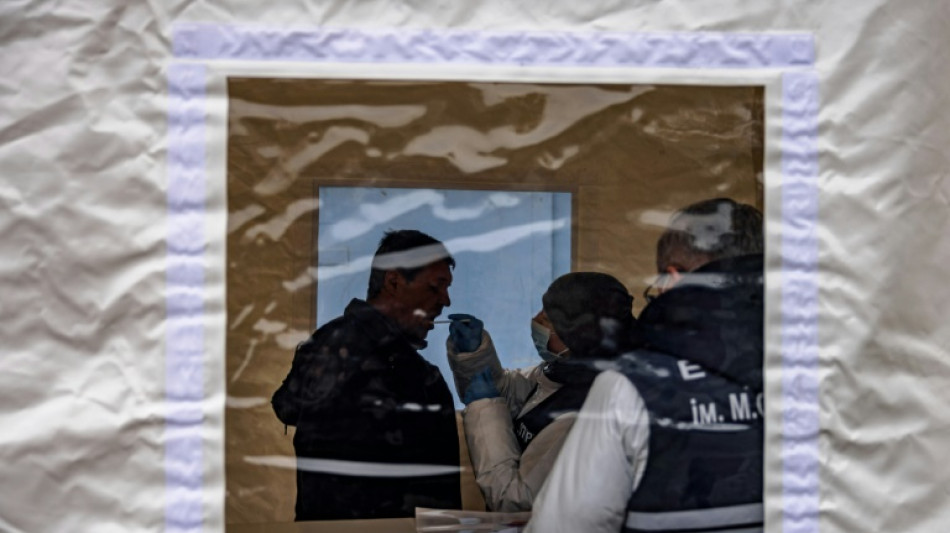
In Ukraine, a mobile DNA lab helps relatives identify bodies / Photo: © AFP
A mobile DNA laboratory was set up this week in Izyum, eastern Ukraine, to spare relatives of the war dead the pain of visually identifying bodies.
Around 50 people came to take part Friday in the DNA sampling organised on a parking lot in Izyum, AFP journalists said.
"I am searching for my father Anatoly Matyshko. His neighbours say he was killed on March 10 by shrapnel and buried in his garden," Inna Kupriyanova told AFP.
"He was unearthed and taken to the Kharkiv morgue, but another body was found in the same garden."
"So I am coming to give my DNA, so that we can really identify my dad and give him a proper burial," the 46-year-old nurse explained.
People genetically linked to a deceased or a missing person spent a few minutes providing saliva samples in a small white van.
The others were instructed to bring a personal item -- ideally, a toothbrush -- belonging to the missing.
The "LAB'ADN" is a mobile structure deployed by the forensics department of the French Gendarmerie Nationale (IRCGN).
It is able to quickly carry out genetic analysis on a large quantity of biological samples.
- Hard to recognise -
France gifted Ukraine the first laboratory in July.
Paris promised to send a second one to Ukraine by the end of the year, France's ambassador to Ukraine Etienne de Poncins announced recently.
Mid-September, authorities found hundreds of graves marked by wooden crosses and number plates in a forest near the eastern Ukrainian city of Izyum, which had been occupied by Russian troops for almost six months.
The 450 bodies that were exhumed were sent for identification in the Kharkiv morgue, the prosecutor's spokesperson told AFP on Friday.
"We heard about this lab so we came here" said 57-year-old Lyuba Yaresheva, accompanied by her sister.
They are hoping to retrieve the body of their nephew, who they fear is among those buried in the forest.
Until the mobile lab was set up people had to go through the painful steps of going to the morgue to identify the corpses, as was the case in Bucha in April.
DNA sampling "helps us to identify the exhumed corpses, because they were there for more than a day... the relatives are often not able to identify them," Viktoriya Bulavina, in charge of the mobile lab, told AFP.
According to the regional prosecutor, 750 bodies have been exhumed from different burial sites since the area was liberated in September.
C.Stevenson--TNT