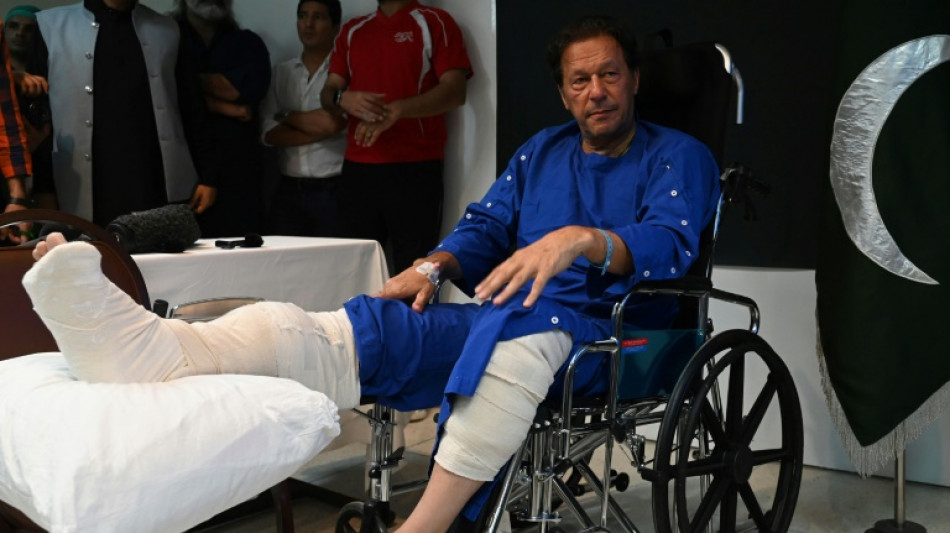
Imran Khan claims Pakistan PM Sharif had role in plot to kill him / Photo: © AFP
Former Pakistan prime minister Imran Khan on Friday accused his successor of involvement in a plot to kill him as he recovered in hospital from gunshot wounds following an assassination attempt.
Khan told reporters that Shehbaz Sharif, who replaced him as premier following a vote of no confidence in April, masterminded the attack along with Interior Minister Rana Sanaullah and a senior army commander.
"These three decided to kill me," Khan said in his first public appearance since Thursday's shooting, adding that two gunmen were involved.
The government has denied any part, and blamed the assassination attempt on a lone assailant fueled by religious extremism.
The attack on Khan's convoy killed one man and wounded at least 10, significantly raising the stakes in a political crisis that has gripped the South Asian nation since Khan's ousting.
The 70-year-old former international cricket star had been leading a campaign convoy of thousands since last week from Lahore to the capital Islamabad.
Sitting in a wheelchair -- his right leg in a cast and left leg heavily bandaged -- Khan spoke for over an hour, railing against the government and establishment he accuses of unseating him.
He said his opponents wanted to accuse him of "desecrating religion, or desecrating the prophet" and would then blame a religious extremist for killing him.
Khan offered no evidence to support his claims.
Sanaullah had earlier said the attack was "a very clear case of religious extremism".
The suspect in police custody, named by Punjab government officials as Naveed Ahmad, said in a video leaked by police to the media that Khan was "misleading the public".
He added he was angry with Khan's noisy convoy for interrupting the call to prayer that summons Muslims to the mosque five times a day.
Khan was looking out at the crowd when bullets were sprayed at his modified container truck as it slowly inched through a thick crowd in Wazirabad, around 170 kilometres (105 miles) east of Islamabad.
"Bullets hit my leg, and when I was falling there was another burst," Khan told reporters.
"There were two men. Had they synchronised well, I would have not survived.
"One of them was caught and he is being touted as a religious fanatic. He was not a religious fanatic -- there was an elaborate plan behind this."
- Threats -
Naveed Ahmad, the man in custody, comes from a poor village near the rally site where Khan was shot.
Neighbours told AFP the father was a "simple boy" with no obvious religious or political leanings.
Pakistan has long grappled with Islamist militancy, with right-wing religious groups having huge sway over the population.
Khan has previously been accused of stoking religious sentiments to broaden his support base.
Pakistan has been no stranger to assassination attempts during decades of political instability, and the powerful military has led the country several times.
Pakistan's first prime minister, Liaquat Ali Khan, was shot dead at a rally in Rawalpindi in 1951.
Another former prime minister, Benazir Bhutto, was killed in 2007 when a huge bomb detonated near her vehicle as she greeted supporters in the city of Rawalpindi.
- 'I'll hit the streets again' -
Khan was booted from office in April by a no-confidence vote after defections by some of his coalition partners, but he retains huge support.
He was voted into power in 2018 on an anti-corruption platform by an electorate tired of dynastic politics, but his mishandling of the economy -- and falling out with a military accused of helping his rise -- sealed his fate.
Since then, he has railed against the establishment and Sharif's government, which he says was imposed on Pakistan by a "conspiracy" involving the United States.
Khan and Sharif have for months traded bitter accusations of corruption and incompetence, raising the political temperature in a nation that is frequently at boiling point.
Khan said he would resume his so-called "long march" on the capital when he had recovered from his wounds.
"One bullet hit the upper part of my leg, one bullet passed near my main artery and another stopped near it," he said, calling his survival "mercy from Allah".
Earlier Friday, scattered protests broke out around the country after afternoon prayers, the most important of the week, with police deploying tear gas in several cities to control crowds.
A.Wood--TNT