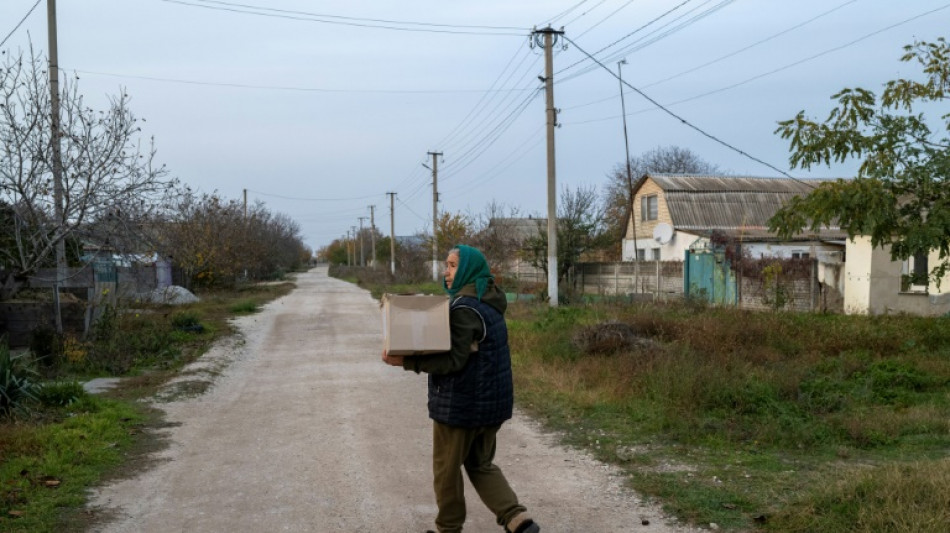
Homesick Ukrainians test luck along Kherson front / Photo: © AFP
Yulia Pogrebna has given up telling homesick villagers that now was not the time to go back to Ukraine's southern front.
The bubbly 32-year-old volunteer was meting out boxes of food to a crowd of pensioners who had given up waiting out the war and returned to the riverside village of Lymany.
The sun dipped over a yawning bay that separates the villagers from Russian forces that poured in from the nearby Crimea peninsula the Kremlin seized in 2014.
Tough-talking Ukrainian troops hidden in surrounding forests were loading Grad rockets onto truck-mounted launchers ahead of the next round in the battle for Kherson.
The hour of nightly exchanges of fire was nearing and the villagers were scurrying to their cellars loaded with weekly supplies of rice and tinned meat.
Pogrebna shook her head and tugged on her bulletproof vest as the sun set.
"It would be a lot easier if these people were not out here," she said with a soft smile.
"But how can you ask someone who has lived in one place for 70 years -- where they know every blade of grass -- to leave? Especially if they have nowhere else to go."
- 'Back to work' -
Ukraine's counteroffensive across the north and push ever deeper into the south has encouraged growing numbers to resettle lands precariously close to the front.
Many return because they cannot afford to pay rent in places more removed from the war zone.
Others feel they have worn out their welcomes with relatives or friends.
And many more simply want to take care of their abandoned country cottages and damaged flats.
"It has gotten a lot better here in the past few days," school janitor Yekaterinodar Dudik said with a resolute nod.
"The last bomb dropped what, five days ago now? I went back to work today," the 27-year-old said.
"I was sweeping leaves."
All but a few hundred of Lymany's 4,000 residents fled when the Russians passed through the village days into their invasion eight months ago.
Local officials say about 1,000 are here today.
"I visit four such villages a week," Pogrebna said. "There are some places we can only reach by foot across fields."
- 'Running out of men' -
The soldiers sliding rockets the length of a car into the tubes of a multiple-launcher system some distance away had no qualms about the villagers' return.
Junior Sergeant Oleksandr Veretennik said artillery battles were still common in the surrounding forests and fields.
"But things are becoming a little easier for us," the 32-year-old said.
"I don't think they are running out of weapons. I think they are running out of men. They seem to be rotating in less and less qualified soldiers."
The Kremlin has sent in reinforcements from all directions toward the city of Kherson -- Ukraine's gateway to both Crimea and the commercially crucial Sea of Azov.
The city's eponymous region runs to within a few minutes' drive of Lymany's fenced-off cottage homes.
The soldiers of the 28th brigade were brandishing drone killer guns and talking up air defence systems that made the skies over Lymany feel slightly safer.
"This is a technology and innovation-driven war. And our engineers are second to none," said a soldier who uses the nickname Balkan.
"I want to extend thanks to our allies, but most of the technology we are using is our own."
- 'Less lonely' -
Russia's retreat on the ground has forced the Kremlin to switch to an air assault involving cruise missiles and suicide drones.
Moscow is mostly targeting power plants and other civilian infrastructure -- a campaign evidently aimed at demoralising Ukrainians by leaving them without winter heat or light.
But Lymany is already cold and dark.
Its residents wheel out gas canisters to boil potatoes and tea in daytime.
Many choose to huddle at night at a central bunker rather than staying in cellars on their own.
Village elder Natalia Panashiy moves around a lot because the building housing Lymany's main offices is now a pile of rubble.
She rushed in to direct the traffic in the noisy queue of locals waiting to pick up their weekly food rations before dusk.
"Of course it is too early for them to be coming back," the 54-year-old said.
"But I am glad that they are because now I feel less lonely out here."
T.Bailey--TNT