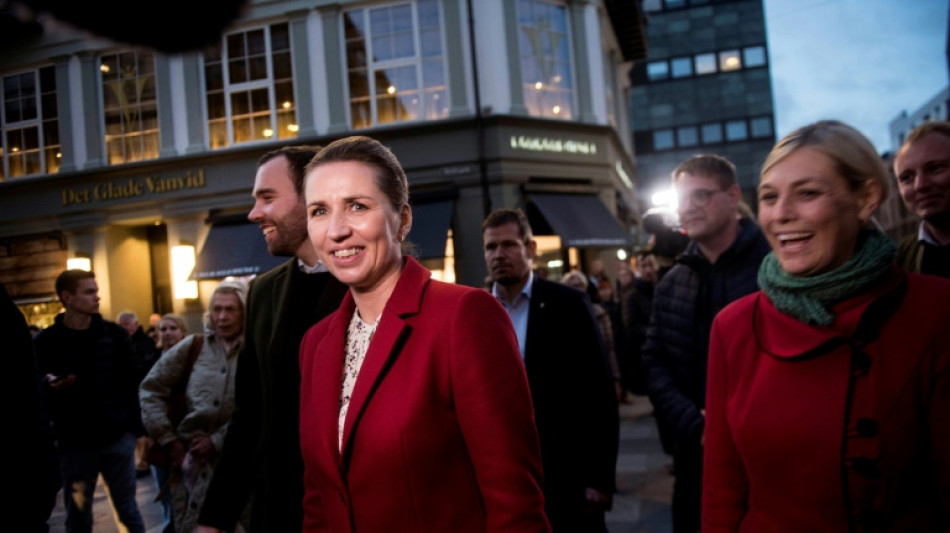
After slim victory, Danish PM to form broader government / Photo: © Ritzau Scanpix/AFP
A day after scoring a narrow election victory, Denmark's Social Democratic Prime Minister Mette Frederiksen tendered her resignation Wednesday to begin the process of forming a new, broader government.
Accustomed to leading minority governments, the Social Democrats -- the largest party in parliament with 50 of 179 seats -- now want to govern across the traditional left-right divide.
The prime minister presented her government's resignation in order "to enter into negotiations to form a broader government and that will probably take a while," political scientist Rune Stubager, a professor at Aarhus University, told AFP.
Frederiksen's left-wing bloc, which includes five parties plus three seats from the autonomous territories Greenland and the Faroe Islands, won a majority of 90 seats, compared to 73 for the right and far-right, and 16 for the centre.
The outgoing prime minister met Queen Margrethe to hand in her resignation at 11:00 am (1000 GMT), which formally set the ball rolling for her to start negotiations with other party leaders on the make-up of the new government.
Having led the Social Democrats to their best election outcome since 2001, gaining two seats and securing over 27 percent of the vote, Frederiksen enters the negotiations from a position of strength.
- Broken dreams -
Up until the final moments of the vote count, it appeared as though the left bloc would lose its majority, a scenario which would have made the newly formed centrist Moderates party kingmaker.
But Frederiksen's photo-finish win scuppered the hopes of former two-time prime minister Lars Lokke Rasmussen, who founded the Moderates just months earlier.
The party won more than nine percent of votes and Lokke Rasmussen insisted he wanted to be "the bridge" between the left and right.
"The dream lasted only a couple of hours," daily Jyllands-Posten concluded.
"Now, in theory, Mette can do without Lars Lokke," the newspaper added.
Despite this, the Moderates "will be part of these negotiations" and could even be able to secure cabinet posts if they are willing to "compromise sufficiently", Stubager said.
"But I don't think they will because they will then be vulnerable to critique from the right-wing parties," he said.
Frederiksen "may then switch to a plan B, which I think is more realistic" -- a coalition government with various parties on the left.
While her government was largely hailed for its handling of the Covid-19 pandemic, the election ended up being triggered by the "mink crisis".
The affair has embroiled Denmark since the government decided in November 2020 to cull the country's 15 million minks over fears of a mutated strain of the novel coronavirus.
The decision turned out to be illegal, and the Social Liberal party propping up Frederiksen's minority government threatened to topple it unless she called early elections to regain voters' confidence.
The Social Liberals paid a price for the gamble, losing nine of their 16 seats.
- 'Zero refugees' -
With the razor-thin majority, the Social Democrats will still depend on the Social Liberals' support to rule, and the party has made it clear it will not support another minority one-party government.
Broad consensus for Denmark's restrictive migration policy left the issue largely absent from the election campaign, but it could resurge in government negotiations.
Advocating a "zero refugee" policy, the Social Democratic government has been working on setting up a centre to house asylum seekers in Rwanda while their applications are processed.
The Social Liberal Party is opposed to the plan.
"It will be very difficult for the Social Democrats to turn soft or to the left on immigration, because that has been a very pivotal point in their strategy over the past five, six years," Stubager said.
"So to give up on that would have dramatic consequences for them."
Danish politics have been heavily influenced by the far-right in recent decades, but three populist parties together won just 14.4 percent of votes and are not expected to play a key role in the upcoming negotiations.
A new party founded by former immigration minister Inger Stojberg, the Denmark Democrats, instead won 8.1 percent giving them 14 seats on a platform of less centralisation, less influence from Europe and fewer immigrants.
V.Allen--TNT