Brazil runoff: 3 key factors / Photo: © AFP/File
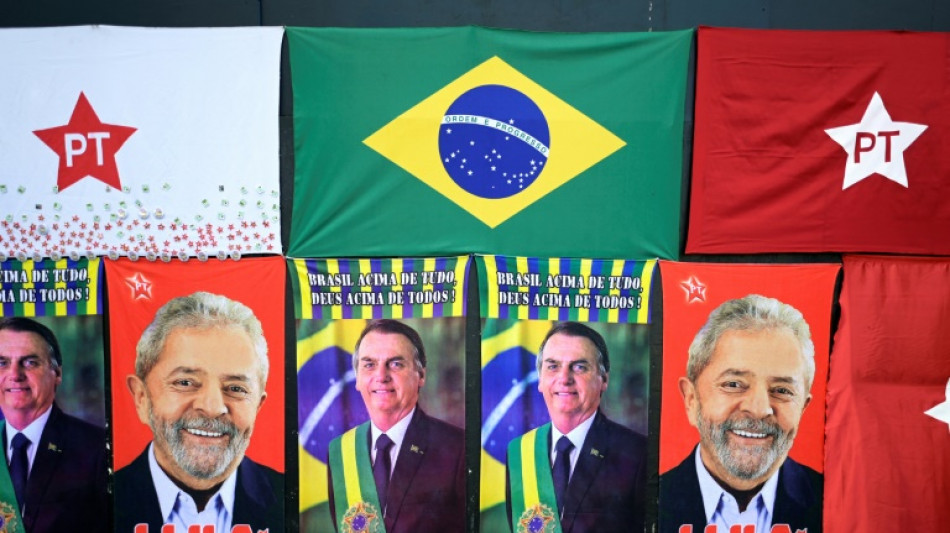
Charisma and campaign strategy won't be the only things in play when Brazil's far-right President Jair Bolsonaro and leftist challenger Luiz Inacio Lula da Silva face off in a polarizing runoff election Sunday.
Here are three key factors analysts say will determine the outcome.
- Rejection -
Millions of Brazilians hate Bolsonaro, Lula or both -- and that rejection vote will play a decisive role, analysts say.
Four years ago, Bolsonaro ran as an outsider, tapping widespread outrage with an economic crisis and massive corruption scandals under the Workers' Party (PT), which governed Brazil for 13 years -- first under Lula (2003-2010), then Dilma Rousseff (2011-2016), who was ultimately impeached.
Now, with Brazil deeply divided over Bolsonaro's hardline conservatism, Covid-19 denialism and vitriolic style, the former army captain has plenty of haters of his own.
"Brazilian politics has two negationist forces: 'anti-PTism' and 'anti-Bolsonarism.' And that will decide the election," says Mayra Goulart, a political scientist at Rio de Janeiro Federal University.
- Turnout -
Around 32 million Brazilians didn't vote in the first-round election on October 2 -- more than five times the six million votes that separated Lula (48 percent) from Bolsonaro (43 percent).
"Turnout will be key" in the runoff, says political scientist Oliver Stuenkel of the Getulio Vargas Foundation.
Poor voters, a group that leans heavily toward Lula, are particularly susceptible to stay home, especially if they lack transportation.
In theory, voting is mandatory in Brazil. But the fine for failing to comply -- 3.5 reais, or a little more than 50 US cents -- costs less than round-trip bus fare.
"The more voters stay home, the worse it will be for Lula," says Stuenkel.
- It's the economy, stupid? -
Latin America's biggest economy is crawling slowly out of its pandemic hole.
Unemployment has fallen from a pandemic high of 14.5 percent to 8.7 percent last quarter, and economic growth is expected to come in at 2.8 percent this year.
But 9.5 million workers are unemployed, 33 million people are living in hunger, and prices remain painfully high for most -- though inflation has started to fall.
"The economy, high inflation... unemployment exacerbated by the pandemic, all contributed to many families' dismay" with Bolsonaro, says sociologist Paulo Baia.
Lula, who is remembered for an economic boom and social programs that helped lift 30 million people from poverty, is leaning heavily on that legacy.
Bolsonaro is meanwhile counting on jacked-up welfare payments to the poor, fuel-price cuts and tentative signs of better times ahead to win over voters.
Ultimately, the economy may not be the decisive issue, though.
Stuenkel says it could be eclipsed by Brazil's culture wars and favorite Bolsonaro themes like "family, Christianity and tradition."
"If (Lula) wins, that will show voters' main concern is the economy," he says.
"If Bolsonaro wins, it will show social conservatism is seen as the most important issue."
C.Blake--TNT