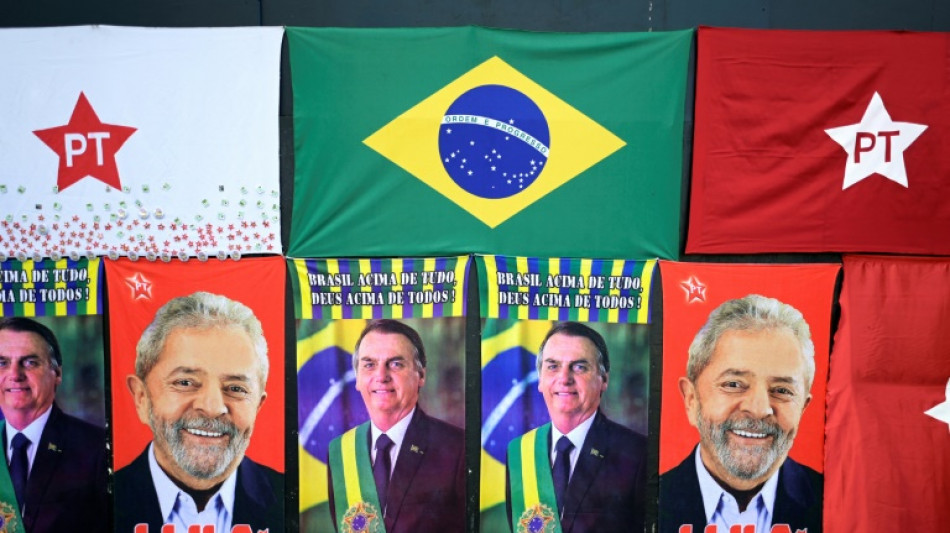
'Make it stop!' Brazilians fed up with long, dirty election campaign / Photo: © AFP
Marcelo feels it is making him sick. Alexia has stopped chatting to her neighbors and Luciene is desperate for it to end: Brazil's lengthy and nasty election duel has left many voters fed up.
Latin America's largest nation is four days from deciding whether to re-elect far-right President Jair Bolsonaro or leftist former leader Luiz Inacio Lula da Silva, who is leading a very tight race.
The two men, both tarnished but with fervent supporters, are locked in a fierce battle for the four percent of voters who plan to spoil their vote and the one percent who remain undecided.
The candidates have flooded the media and social media with their presence, and the election has dominated conversation for months.
"I am getting sick because there is a lot of disagreement," said 51-year-old Marcelo Brandao Viana, a Bolsonaro supporter who laments a campaign "overloaded" with "fake news" and attacks between the rival parties.
"I am living this 24 hours a day, and it is horrible," the bank receptionist told AFP. Nevertheless, he cannot resist looking at his WhatsApp groups during his lunch break outside a mall in the capital Brasilia.
Meanwhile, on Copacabana beach in Rio de Janeiro, 65-year-old Jose Guilherme Araujo sits on a beach chair in a tight, bright green swimsuit bearing the Brazilian flag as he tries to escape the electoral noise.
"I feel exhausted. I am fed up," the lawyer told AFP, adding he plans to spoil his ballot.
"The main television channels are only talking about the election. It is horrible. I try to watch cable to escape the subject."
- Don't talk about politics -
A final showdown between Bolsonaro and Lula had been on the cards since last year when the leftist former president had longstanding corruption charges overturned for procedural reasons, and was freed from prison, without being exonerated.
Many Brazilians feel the election campaign began then, long before voting season, especially because both candidates draw strong measures of adoration and hatred.
In Sao Paulo, Alexia Ebert put her apartment building WhatsApp group on mute after it became an endless thread of political information and disinformation.
"I couldn't take it anymore," said the 22-year-old student.
Some, like Aline Tescer, a 35-year-old from Sao Paulo, said that any policy proposals for the next four years are conspicuous by their absence.
"I see myself the same as in the last election. It is always the same things, the same accusations, and I feel I have no choice in who to vote for."
Luciene Soares, a businesswoman from Brasilia, feels "disappointed" by the "disrespect" instigated by Bolsonaro.
"People are afraid. I prefer not to say who I am voting for because one is afraid of people's reactions. I don't talk about politics because it creates problems," said the 48-year-old.
"Among friends and family, we say: 'God! Make it stop.'"
- Anesthetised electorate -
This fatigue has not shown up in weekly election polls, but experts have picked it up on the streets and online, in this country which has 171.5 million users (80 percent of the population) on social media, according to a study carried out by the Hootsuite and We Are Social agencies.
The constant bombardment of information "ends up anaesthetizing the electorate" and "tiring them out", said Amaro Grassi, a sociologist with the Getulio Vargas thinktank.
"The permanent presence of campaign content is not new in this election, but has become much more accentuated," he added.
Grassi remarks that most Brazilians just want to get back to their normal lives and "turn the page" on the bruising campaign.
"Today, politics has even become a topic of conversation on gossip sites," said Sao Paulo resident Iamylle Kauane, on a visit to Rio.
This 21-year-old social assistant is waiting for the elections to end "to return to normalcy."
Nevertheless, some are indefatigable.
"I don't feel tired," said Leandro Albino Oliveira, 36, selling hats on a Rio beach.
"We will not rest until our president is re-elected."
F.Hughes--TNT