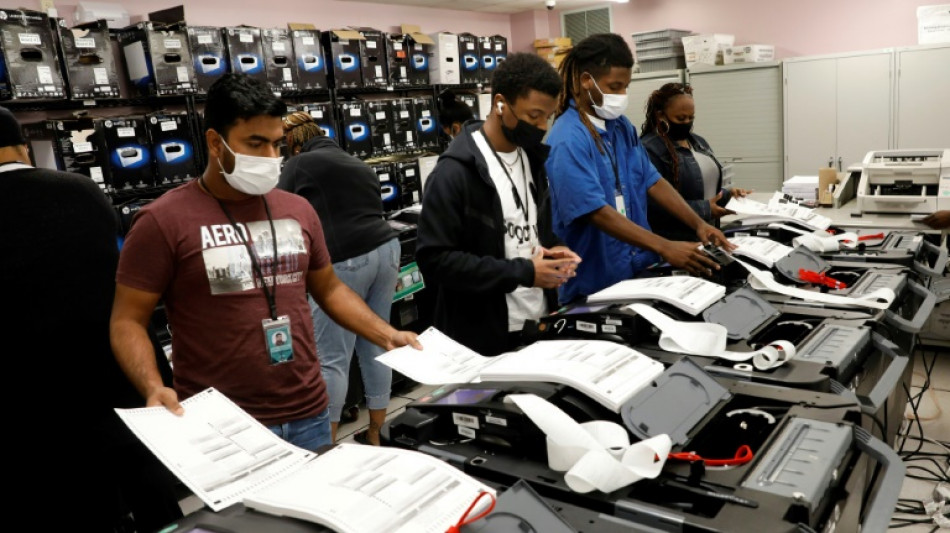
US midterm elections: misinformation to watch out for / Photo: © AFP
With midterm election campaigns in the closing stretch, Americans could face an onslaught of misinformation about the results. Recent trends suggest alleged voter fraud will be one of the biggest themes.
Claims of foul play -- despite being repeatedly debunked after the 2020 presidential election -- have permeated voters' minds. Nearly 40 percent of Republicans and a quarter of Democrats might blame fraud if their party does not win control of Congress on November 8, according to a recent Axios-Ipsos poll.
Such an outlook, with social media weaponized by political operatives and potentially by foreign actors, poses an ongoing risk to democracy in the United States.
"There is going to be a continued effort to undermine confidence in the system," warned Larry Norden, senior director of the Elections and Government Program at the Brennan Center for Justice, a liberal-leaning think tank, citing "lies around the election" as his biggest fear.
False and misleading claims are bubbling up.
In Colorado, partisan websites misconstrued a database error as a coordinated effort by Democrats to get non-citizens to vote. Social media posts in Alaska and Ohio misled some voters into believing that mail-in ballots without the proper postage would not be counted.
Election officials across the country have set up webpages to prepare for a misinformation deluge. Still, two years on from debunked conspiracy theories and dozens of defeated court cases from former president Donald Trump and his allies, experts say partisan beliefs are unbowed.
"We do have some portion of the American public that does not believe in the legitimacy of the 2020 election -- despite all of the extensive evidence," said Jen Easterly, director of the Cybersecurity and Infrastructure Security Agency (CISA), during a press briefing this month.
With voters increasingly likely to turn to social media for updates, experts recommend taking claims of a rigged election with extreme caution.
"In fact, our election systems are quite secure," said Rick Hasen, a law professor and fraud expert at the University of California-Los Angeles (UCLA). "Voter fraud tends to be small and isolated."
- Fraud is rare -
The 2020 presidential election was the most secure in American history, according to CISA. Litigation, audits and recounts have since backed that up, contradicting repeated claims from Trump that stolen votes put Joe Biden in the White House.
"None of the charges of widespread fraud turned out to be true," said Charles Stewart, director of the Massachusetts Institute of Technology Election Lab, while noting "this is not the same thing as saying there was no fraud."
Isolated cases were detected after the last general election. But of the more than 65 million absentee ballots cast in 2020, there have been 12 criminal fraud convictions, according to a database maintained by the conservative-leaning Heritage Foundation think tank.
Studies compiled by the Brennan Center, which reviewed fraud cases prior to 2020, also found wrongdoing is uncommon. Americans are more likely to get struck by lightning than impersonate someone at the polls, according to a 2007 report from the policy institute.
"When fraud occurs in elections, it's most likely to occur for small, local elections where there's not a lot of attention being paid," Stewart said. "The fraud claims for really big elections are particularly rare."
Americans who do commit such crimes face harsh penalties. Those convicted on charges related to the 2020 election were fined thousands of dollars, and some face jail time.
"Voters should look to official sources of information -- and to experts and those in the press who focus on election issues -- to figure out when claims of vote-rigging are legitimate or just more nonsense," said Hasen of UCLA.
- Ballots are verified -
Claims of dead people voting and videos supposedly showing malfeasance at the polls reached large audiences in 2020. But there are numerous safeguards to prevent ballot tampering in person, and by mail.
Elections officials verify the eligibility and identity of voters requesting absentee ballots by using techniques such as signature matching. They also implement several security measures, including locks and tamper-evident seals, to protect drop boxes.
Once ballots are cast, there are "protocols in place for assuring the chain of custody," Stewart said.
"Every step along the way, election workers are recording how many ballots they have, who's transporting them (and) numbers are reconciled at every place they're removed or exchanged."
W.Phillips--TNT