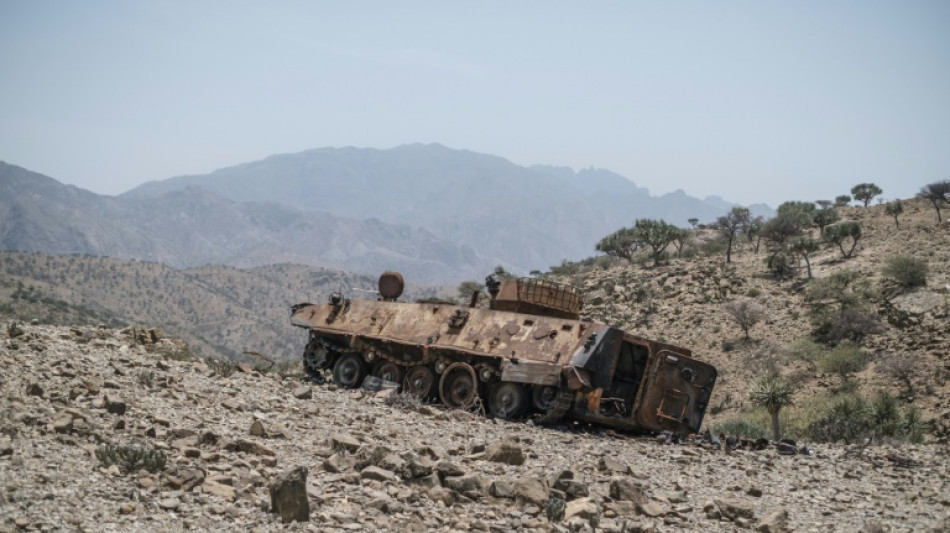
Tigray's rebels agree to peace talks as Ethiopia PM vows 'end' to war / Photo: © AFP/File
Tigray's rebel authorities said Friday they would attend talks next week aimed at ending war in Ethiopia, as Prime Minister Abiy Ahmed vowed fighting "will end and peace will prevail".
The government has also said it will participate in the negotiations in South Africa on Monday, being organised by the African Union, as diplomatic pressure mounts for a settlement to almost two years of bloodshed.
"Our delegation will attend," Kindeya Gebrehiwot, a spokesman for the rebel authorities in Tigray, told AFP in a text message when asked if they would come to the table on October 24.
The news came ahead of a closed-door meeting of the United Nations Security Council on Friday to discuss the spiralling conflict in Africa's second-most populous country, and growing fears for civilians caught in the crossfire.
Ethiopia's government this week vowed to seize airports and other federal sites in Tigray from rebel control as its army and their Eritrean allies seized towns in the war-torn region, sending civilians fleeing.
Abiy, who sent troops into Tigray in November 2020 promising a quick victory over the northern region's dissident leaders, said the war "would end and peace will prevail."
"Ethiopia will be peaceful, we will not continue fighting indefinitely," the Nobel Peace Prize winner said Thursday at a project launch outside Addis Ababa.
"I hope the day when we will stand with our Tigrayan brothers to work together for development is near."
- 'Dramatic' violence -
International calls for a ceasefire have grown since the AU failed earlier this month to bring the warring sides to the negotiating table, and fighting intensified in embattled Tigray.
The AU's Peace and Security Council, its foremost conflict resolution body, met for the first time Friday since fighting resumed in August, shattering a five-month-long truce.
In a communique, the 15-member council welcomed "the mutual commitments to genuinely participate in the peace process" and hoped for a "fruitful outcome".
The return to the battlefield in August halted desperately-needed aid into Tigray, a region of six million that lacks food, medicine and other life-saving essentials.
A humanitarian source told AFP on Friday that heavy fighting was underway between the cities of Shire and Axum in northern Tigray, where combat has intensified in recent weeks.
EU foreign policy chief Josep Borrell warned of a "dramatic escalation of violence".
"The number of casualties and the level of human suffering is staggering", he posted on Twitter on Friday.
Tigray has been under a communications blackout for over a year, and independent reporting from the region has heavily curtailed.
The International Crisis Group said that, while reliable data was scarce, it believed the fighting since August "may have involved more than half a million combatants and killed tens of thousands of people".
"According to most estimates, it is among the world's deadliest conflicts," the Brussels-based think tank said in a report published Friday.
- 'Great concern' -
US State Department spokesman Ned Price said the UNSC and AU meetings "demonstrate the international community's great concern about the situation" and the need for the violence to stop.
Speaking to reporters on Thursday, he also renewed calls for a resumption of humanitarian aid to Tigray, and the withdrawal of Eritrean troops from Ethiopia.
Price said US special envoy Mike Hammer was in Addis Ababa and in "constant touch" with the participants in the peace talks, including Kenya and South Africa.
The AU's mediation team was to include Horn of Africa envoy Olusegun Obasanjo -- who briefed the peace council on Friday --South Africa's former deputy president Phumzile Mlambo-Ngcuka, and former Kenyan president Uhuru Kenyatta.
Logistical problems were blamed for peace talks scheduled earlier this month never eventuating.
The AU was "widely perceived as responding inadequately to this situation" but had been trying to ensure talks got started next week as planned, the AU-focused Amani Africa think tank said Friday in a briefing note.
The conflict began nearly two years ago when Abiy accused the Tigray People's Liberation Front (TPLF), the region's ruling party which resisted central authority, of attacking army camps.
The TPLF dominated Ethiopia's ruling political alliance for decades before Abiy took power in 2018 and sidelined the party.
B.Scott--TNT