Ukraine war further divides Kosovo's rival communities / Photo: © AFP
utIn the deeply divided Kosovo city of Mitrovica, the fighting in Ukraine has added another wedge between Serbs and ethnic Albanians, where the conflict has stirred bitter memories of their own war.
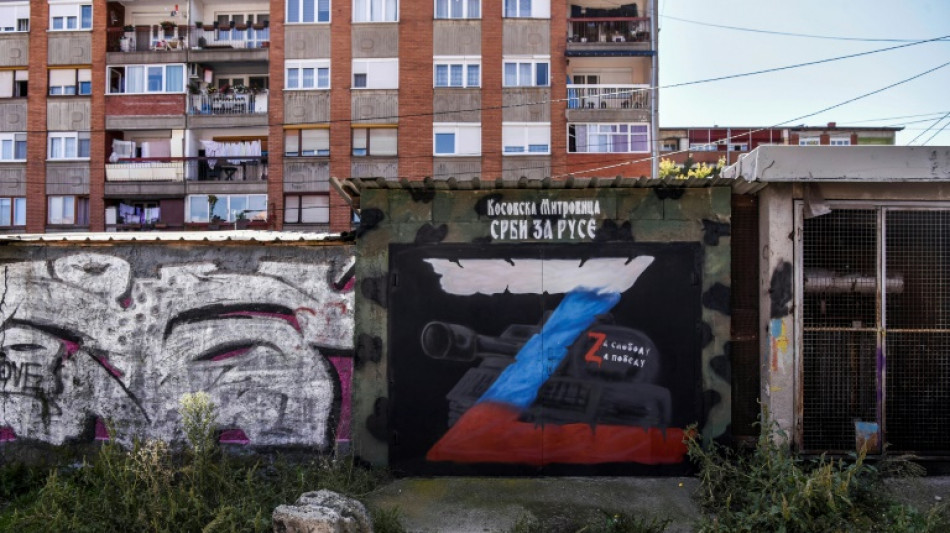
North of the Ibar River where the city's 20,000 Serbs live, a smattering of pro-Russian murals have appeared in recent months, trumpeting the Kremlin's invasion of Ukraine.
"Serbs are for Russians, for freedom and victory," reads the writing under a picture of a tank and the letter Z -- the ubiquitous symbol of the Russian military since the war's onset.
For many Serbs, Russia has long been a close ally and friend, with their shared Orthodox faith and intertwined history considered a source of pride.
That long history and the shared hatred of the NATO alliance -- which bombed Serbian forces during the war in Kosovo in the late 1990s -- has made the choice to side with Russia a natural one.
"I support both Russia and Putin," Branka Sofric, a 20-year-old literature student, told AFP, saying Russian President Vladimir Putin "is a man who fights for his people."
"You know, [Putin] is probably right because he did it," pensioner Dragoljub Kovac, 75, said of the invasion.
Murals often serve as public platforms for ultranationalists across much of the Balkans, where war veterans, political slogans and football clubs are glorified and threatening messages against perceived enemies are aired.
For years, one mural in Mitrovica's Serb enclave has proclaimed "Kosovo is Serbia, Crimea is Russia" -- a common refrain now chanted at pro-Russia rallies held in Serbia since the outbreak of the war.
- 'A bloody letter' -
But on the other side of the bridge over the Ibar where most of the 80,000-strong ethnic Albania community resides, there are no feelings of brotherly love for Russia.
"Here you don't see a 'Z'," Ekrem Vllahiu, a 24-year-old cigarette seller, told AFP. "Why? Because it is a bloody letter."
The bridge that divides the communities has been the regular scene of clashes following the 1999 war between Serbian forces and Kosovo's ethnic Albanian majority, which left 13,000 dead and ended after a NATO bombing campaign led by Washington.
NATO troops are still stationed in Kosovo and continue to patrol the streets alongside local police in Mitrovica in a bid to head off any future unrest.
On the city's southern and Albanian side, the US flag is ubiquitous and official buildings often bear the symbols associated with NATO and the European Union.
"Justice is on the side of Ukraine," said Dan Syla, an 81-year-old retired fireman. "They suffer what we suffered ourselves," he added, referring to the war with Serbia.
Kyiv, however, has never officially recognised Kosovo's independence from Serbia, which was declared in 2008 and is now accepted by more than 100 countries across the world.
But since the beginning of the war, the government in the capital in Pristina has joined sanctions against Russia, welcomed Ukranians fleeing the war, trained demining teams and even hosted a film festival usually held in the Black Sea port of Odessa.
- 'God first, America second' -
At the heart of the latest spat, experts argue, is the starkly different feelings about the US and the role it plays in international affairs.
"Support for Russia is a manifestation of anti-Americanism. The perception of the Serbs is that it was because of the United States that Kosovo was taken away from them," said Nexhmedin Spahiu, a professor of political science in the Kosovan capital Pristina.
"For Albanians, the United States represents freedom," he added.
Syla, the retired fireman in Mitrovica, agrees.
"God first, America second," he gushed.
Miodrag Milicevic -- the director of Aktiv, a nonprofit in Serb north Mitrovica -- believes that the current conflict has only further reinforced the "two very different realities" in the divided city that is a result of "the absence of any dialogue" between the communities.
"In this kind of environment, frankly, our prospects, regardless of our community, are not very bright," he added.
For a 28-year-old Serb student called Uros, who identifies more as "anti-Western" than a "Russophile", the choice in the latest war is simple.
"As long as one nation is generally declared the bad guys, I am on their side," he told AFP.
A.M.Murray--TNT