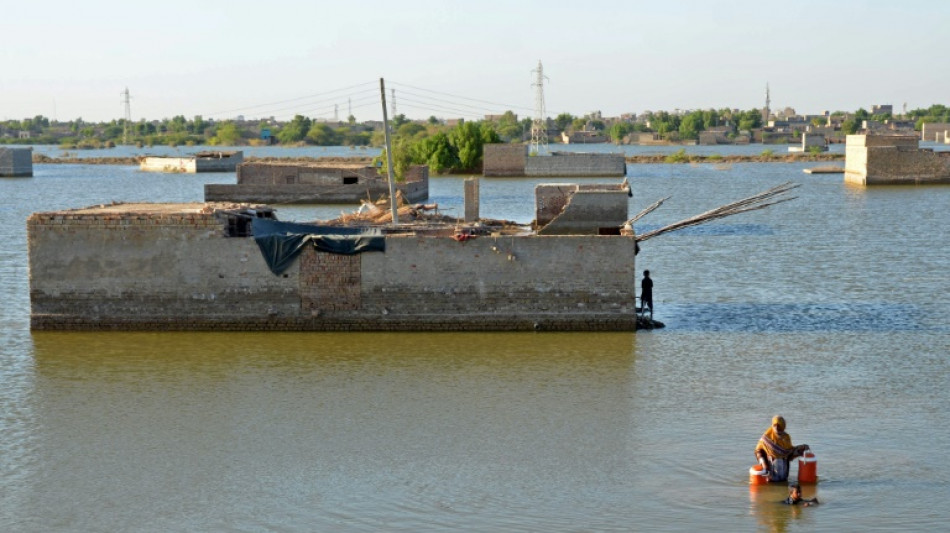
Denmark paves the way for 'loss and damage' climate aid / Photo: © AFP/File
It may seem a drop in the ocean, but the $13 million Denmark has earmarked as aid for climate change-related "loss and damages" set an important precedent.
It might just end up helping open a fresh flow of aid to the world's most vulnerable countries.
Danish Development Cooperation Minister Flemming Moller told the UN General Assembly last month the money was for "climate adaptation and concrete activities to avert, minimise and address climate-induced loss and damage".
It would mainly help island states and countries in the Sahel region of North Africa, he added.
Denmark's gesture, however modest, represents an important contribution to the debate over the still-contentious notion of "loss and damages".
"In some ways, Denmark is a pioneer," said Lily Salloum Lindegaard, who specialises in the politics of climate change at the Danish Institute for International Studies.
Only Scotland and Belgium's Walloon government have made such commitments previously, she added -- and on a modest scale.
"But Denmark's commitment provides further progress if we are to address the extensive losses and damages already experienced due to climate change," Lindegaard told AFP.
"In comparison to the needs on the ground, the Danish commitment is quite small" given the scale of the problem.
But, she added: "The Danish commitment is more significant in political terms, as developed countries have long shied away from finance to losses and damages."
- Pushback -
As the consequences of global warming -- measured in lives lost and economic damages -- have piled up, calls for loss and damage as a separate category have mounted.
Developing nations see this kind of funding as compensation -- a form of reparations -- above and beyond "adaptation" support to build resilience against future impacts.
Rich nations, while acknowledging the need that developing nations have for aid, remain wary of setting a legal precedent that might suggest liability for any and all future damages.
"Climate finance to date has basically only gone to preventing climate change impacts and related losses and damages through mitigation and adaptation efforts," said Lindegaard.
And not every country is willing to go further, she added.
"There has already been some pushback from the US," said Lindegaard.
"However, the science of loss and damage is already quite clear and continues to develop quickly, which makes it increasingly difficult for countries to sidestep the issue."
- 'We are committed' -
As climate change amplifies the devastation of extreme weather events, pressure is mounting on developed nations to do more to help.
The world's most vulnerable countries in the Global South are least responsible for causing the problem -- the G20 group of major economies account for 80 percent of greenhouse gas emissions today, and even more historically.
Pakistan -- a nation of 220 million that has seen record monsoon rains this year linked to climate chang -- emits less than one percent.
Denmark's announcement at the UN Assembly General sent a clear message, Danish Development Minister Flemming Moller Mortensen told AFP.
"We are committed to helping the people and communities that are suffering from the consequences of climate change.
"These are the people that are losing their houses to floods, the farmers that are losing their harvest because of drought".
- Start of a dialogue -
At last year's COP26, developing countries did not get the commitments they were looking for on targeted financial commitments.
Rich countries agreed only to begin a two-year dialogue on the issue running through 2024.
Denmark spends some $2.9 billion annually on development aid according to the OECD, equivalent to about 0.7 percent of gross national income.
It has set a target of spending at least 60 percent of its aid on climate adaptation, and is the first country to specifically allocate funds to redress its impacts.
But even Denmark's commitment is short on details.
Its funds will be distributed between NGOs and a strategic initiative with details forthcoming, said the foreign ministry.
Their announcement was nevertheless widely seen as setting an important precedent.
It remains to be seen whether other countries will follow suit.
M.A.Walters--TNT