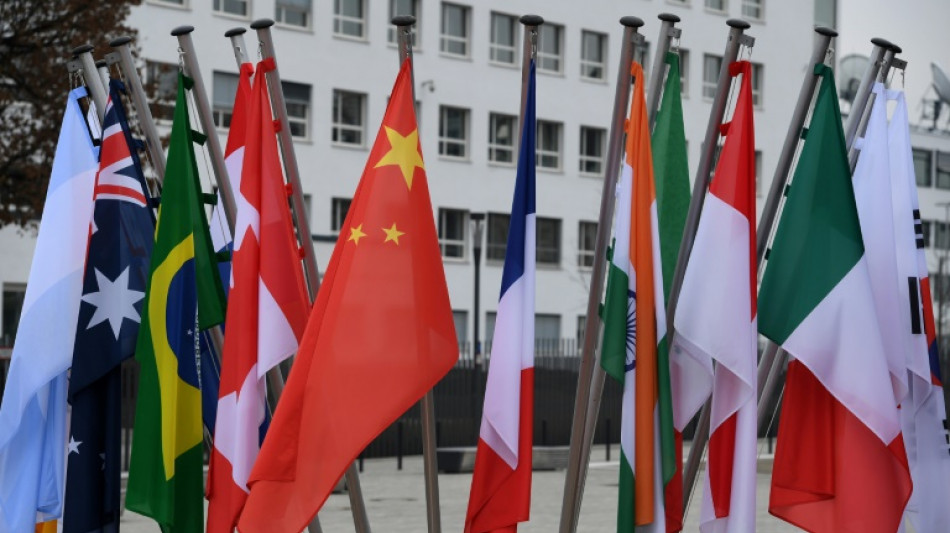
G20 struggles for harmony again, as US-Saudi spat emerges / Photo: © AFP/File
The G20 closed talks in Washington on Thursday without issuing a joint communique, as a growing US-Saudi feud created new tensions in a group already divided over Russia's invasion of Ukraine.
Finance ministers and central bankers from the Group of 20 major economies met during the IMF and World Bank annual meetings that have focused on the war, soaring inflation and the climate crisis.
But the G20 failed to issue a joint communique at the end of its meeting, as in its last two gatherings. Russian officials participated via video link, according to a source familiar with the talks.
Despite the lack of consensus, officials said the G20 remains a useful forum, with heads of state and government due to meet next month in Bali, Indonesia.
"All member countries underlined that it is very important to continue to preserve this G20 as the premier economic forum for cooperation," Indonesian Finance Minister Sri Mulyani Indrawati, whose country chairs the G20 this year, said at a news conference.
She acknowledged that the group faces "many challenges" and "differences in view", with "escalating geopolitical conflicts, a war in Ukraine which exacerbated and worsened the economic situation."
German Finance Minister Christian Lindner said before the meeting that it was "better to have a forum to speak in than none."
"Even if there are different opinions -- including those that you don't share, some even that you don't understand -- it's still a good forum for a conversation," Lindner told reporters.
"We could do a communique that doesn't mention the war in Ukraine, but we don't want a communique that sweeps things under the rug," the source familiar with the discussions told AFP.
- Saudi-US spat -
Washington and Riyadh have locked horns over a decision by the OPEC+ group of oil exporters, led by Saudi Arabia and Russia, to sharply cut production -- a move that could send energy prices soaring higher.
The source close to the G20 discussions said Western nations explained at the meeting that they were "disappointed" and that the cuts went against Saudi interests "because the risk for them is that they cause a recession."
"It's hard to understand," the source said.
President Joe Biden threatened "consequences" for Saudi Arabia in a CNN interview on Wednesday.
In a rare statement on Thursday, the Saudi foreign ministry denied that the decision was "politically motivated against the United States" and expressed its "total rejection of these statements that are not based on facts."
But US National Security Council spokesman John Kirby responded that Riyadh knew the cut "would increase Russian revenues and blunt the effectiveness of sanctions. That is the wrong direction."
- Oil price cap -
The OPEC+ cut comes as the Group of Seven wealth democracies is seeking to impose a price cap on Russia's crude exports, a move aimed at stripping the country of a major source of funding for its war machine.
But gaining broad global approval for a price cap may prove to be a major challenge.
While Western nations have imposed unprecedented sanctions on Russia, other countries have maintained economic ties with Moscow, with India and China stepping up their purchases of Russian oil.
Despite the lack of a joint communique, Indrawati said the G20 made progress on a number of issues, including sustainable finance and efforts to impose a global minimum tax on major corporations.
Tensions within the G20 come as leaders are due to meet in Bali next month -- a summit that could see Biden share the same venue as Russian President Vladimir Putin and another rival, Chinese leader Xi Jinping.
The lack of consensus within the group also comes ahead of the United Nations' COP27 climate summit in Egypt in November.
L.Graham--TNT