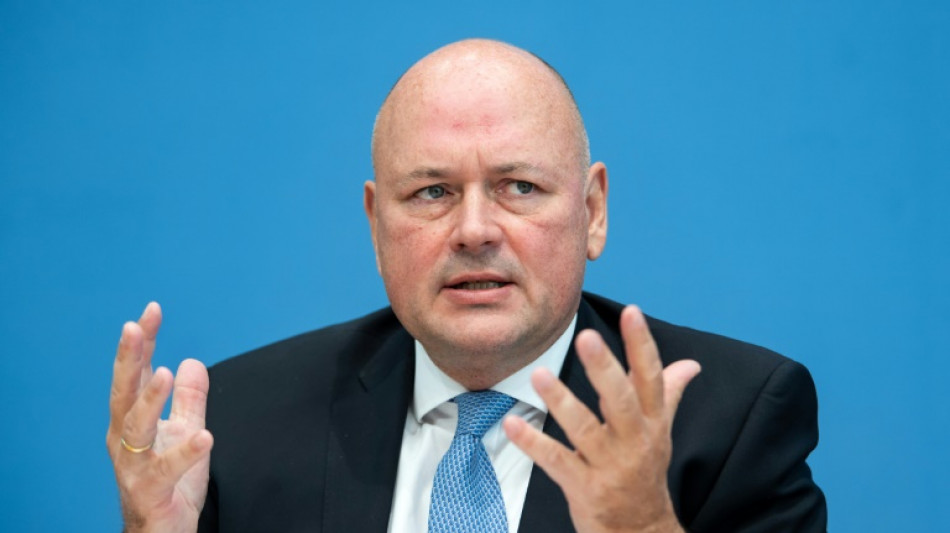
German cybersecurity chief faces sack over alleged Russia ties: sources / Photo: © POOL/AFP/File
Germany's cybersecurity chief is facing the sack over alleged ties with Russian intelligence services, government sources told AFP on Monday, amid heightened vigilance over potential sabotage activities by Moscow.
Arne Schoenbohm, head of the Federal Cyber Security Authority (BSI), was accused in a recent investigation by broadcaster ZDF of contacts with Russia through an association he co-founded in 2012.
The interior ministry said it was "taking the facts that have been reported seriously and investigating them comprehensively" and was "examining all options on how to deal with the situation".
The Handelsblatt daily reported that there was "great annoyance" within the government over the allegations.
A planned joint appearance by Schoenbohm and Interior Minister Nancy Faeser to present a report on German cybersecurity in 2022 has been cancelled as the ministry seeks to clarify the allegations.
Faeser on Monday said her ministry was "examining all necessary steps that may be required" with regard to Schoenbohm.
Germany was "vulnerable" to cyberattacks, "especially due to the threat posed by Russia's war, and we must do everything we can to master this threat", she said.
The association at the centre of the allegations, known as the Cyber Security Council Germany, advises businesses, government agencies and policymakers on cyber security issues.
According to the popular satire programme on ZDF that broke the story, Schoenbohm still maintains contact with the organisation.
The latter denied the allegations, saying in a statement on its website on Monday that the charges were "absurd".
Sebastian Fiedler, a politician with Chancellor Olaf Scholz's Social Democrats (SPD), said the accusations "must be investigated very thoroughly" and had already caused "a great deal of damage to trust in the BSI".
- 'Increased vigilance' -
Germany has in recent years repeatedly accused Russia of cyber espionage attempts.
The most high-profile incident blamed on Russian hackers to date was a cyberattack in 2015 that paralysed the computer network of the lower house of parliament, the Bundestag, forcing the entire institution offline for days while it was fixed.
Russia denies being behind such action.
Tensions between Russia and Germany have only intensified since Moscow's invasion of Ukraine.
The BSI has warned that companies, individuals and critical infrastructure are at risk of being hit by Russian cyberattacks.
Just two days ago, the rail network in the north of the country was temporarily paralysed by what operator Deutsche Bahn called "sabotage", with some officials pointing the finger at Russia.
Important communications cables were cut at two sites, forcing rail services to be halted for three hours and causing travel chaos for thousands of passengers.
Transport Minister Volker Wissing said on Monday the period since Russia's invasion of Ukraine had been one of "increased vigilance" for Germany because "infrastructure has been targeted by many perpetrators".
"Since we don't know who the perpetrators are, we can't rule out anything right now," he said of the rail shutdown.
Russia is also suspected of being behind explosions last month that set off leaks in the Nord Stream 1 and 2 gas pipelines, which connect Russia to Germany.
The pipelines had long been at the centre of geopolitical tensions because Russia cut gas supplies to Europe in suspected retaliation against Western sanctions over Moscow's war on Ukraine.
Anton Hofreiter, a Green party lawmaker and chairman of the German parliament's European affairs committee, said that since the Nord Stream leaks "pointed to the Kremlin... we can't rule out that Russia could also be behind the attack on the rail services".
V.Allen--TNT