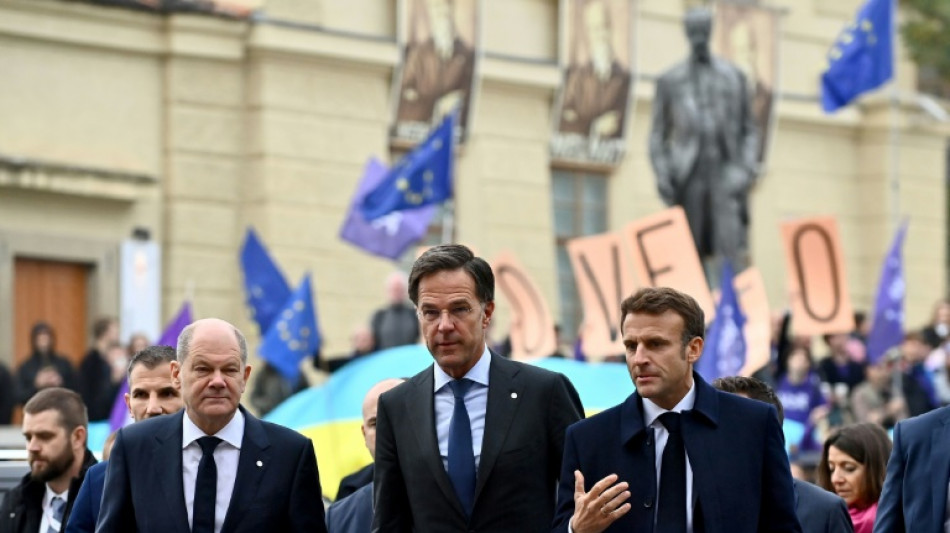
EU leaders struggle for common response to energy crisis / Photo: © AFP
EU leaders meeting in Prague on Friday looked to bridge divisions on how to tackle soaring energy prices as they grapple with the fallout from Russia's war on Ukraine.
President Volodymyr Zelensky was dialling in from Kyiv as the bloc looks to maintain its economic and military support for Ukraine and hold a tough line against Moscow.
EU leaders were also discussing how to better protect their critical infrastructure in the wake of leaks from the Russia-Europe Nord Stream gas pipelines that have been blamed on "sabotage".
But it was the sharp disagreements over how to tackle the energy crisis that were the major focus of attention as the 27 nations wrangled over the best plan to try to bring down prices.
Europe is facing an energy crunch as the price of electricity generation skyrockets because of a massive surge in gas prices caused by Russia turning off the taps.
Governments across the bloc are scrambling to lower the costs for their consumers, but they rely on different sources for their energy and are split over the solutions.
EU executive head Ursula von der Leyen is proposing a "roadmap" of measures to help ease the burden -- including potential moves to cap the price of gas.
However, there is no consensus on how any caps could work and leaders are not set to take a firm decision until a summit in Brussels later this month.
"Now, it is time to discuss how we can limit the peaks in the energy prices and the manipulation of energy prices by (Russian President Vladimir) Putin," von der Leyen told journalists.
"This will be the discussion about price caps, the question where to put them and how to put them."
- 'Common denominator' -
More than half of the bloc have pushed for the EU to impose a price ceiling on how much it would pay for gas piped or shipped in, as the northern hemisphere winter sets in.
But Germany has so far stood in the way over fears that the move could divert precious supplies away from Europe.
"A price cap on gas if that could be achieved would be grand, with the caveat that we cannot endanger security of supplies," said Latvian Prime Minister Krisjanis Karins.
"We cannot set the price so that no one would sell gas into Europe."
Berlin has come under fire from other EU members for dragging its feet on the issue while announcing a 200-billion-euro ($199-billion) fund to subsidise gas purchases at home.
"My message to Germany is be united with all the others because during difficult times everybody has to agree on a common denominator," Polish Prime Minister Mateusz Morawiecki said.
The difficulty of trying to curb prices from energy suppliers was highlighted Wednesday by the OPEC+ cartel's agreement to cut oil production in defiance of Western efforts to starve Moscow of revenue.
That decision appeared to undermine a G7 push for a cap on the price of Russian oil that was backed by the EU in its latest package of sanctions agreed this week.
Despite some discontent from Hungary, the bloc has managed to remain largely united in its opposition to the Kremlin as Putin has escalated the conflict by claiming four occupied regions.
A broader summit of 44 nations from across Europe held in Prague on Thursday highlighted Moscow's isolation.
The EU is looking to maintain its backing for Kyiv as Zelensky's troops push Russian forces back on several fronts over seven months into the war.
Ukraine is urging the EU to speed up much needed economic support after Brussels on Monday signed a memorandum of understanding to provide five billion euros.
On the military front, the bloc is looking to launch a training mission for Ukrainian forces later this month.
It is also eyeing a possible fresh tranche of funding for arms for Ukraine that would take its overall spending on weaponry to three billion euros.
"Ukraine needs our support not tomorrow, Ukraine needs support today, right now," said Lithuanian President Gitanas Nauseda.
V.Bennett--TNT