Calgary budget hearing delayed during debate over Tourette syndrome accommodation
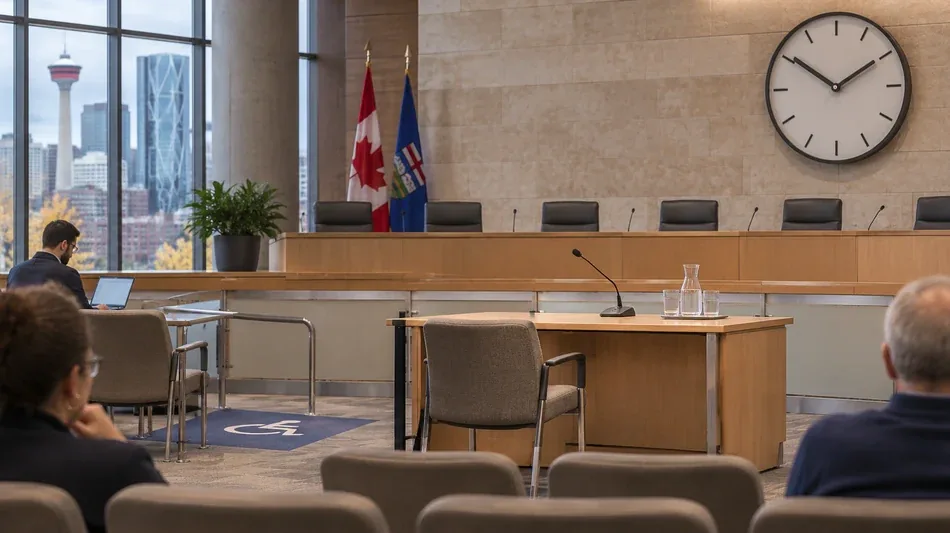
A Calgary budget hearing paused for more than an hour while councillors debated how to accommodate a public speaker with Tourette syndrome and coprolalia.
Friday’s Calgary budget public hearing was delayed for more than an hour as councillors grappled with how to handle a speaker with Tourette syndrome who uttered vulgar remarks during his presentation.
Matt Riley made a presentation at Calgary city council Friday afternoon. Riley has coprolalia — a less common symptom of Tourette’s that causes involuntary swearing — and during his submission several vocal tics could be heard, along with multiple breaks where vulgar phrases were used.
Speaking by phone, Riley discussed councillor salaries, the gap between council decisions and household concerns, and the pressures facing seniors on fixed incomes and people with disabilities.
Riley argued that people who built Calgary, including seniors and residents with disabilities, expected council to make responsible decisions about spending priorities.
An involuntary profane phrase interrupted Riley as he challenged council’s claim that growth should pay for growth.
At that point, Ward 10 Coun. Andre Chabot requested a point of privilege, asking the chair to address the vulgarities. At the time, it was Ward 7 councillor and deputy mayor, Myke Atkinson, who acknowledged Riley’s disability and told council that the speaker had made the City Clerk aware of his condition.
Atkinson asked the speaker to recognize Coun. Chabot’s concerns about the language.
Riley called the interruption discriminatory and said drawing attention to his condition could intensify his tics.
He stressed that people with Tourette syndrome have a right to participate in public proceedings and said he had chosen to speak by phone out of consideration for those in the chamber.
Chabot rose on another point of privilege.
At that point, Deputy Mayor Atkinson recessed the meeting to the call of the chair.
Coun. Jennifer Wyness defended Riley’s right to address the hearing in public.
Ward 2 Coun. Jennifer Wyness stated that this was a member of the public who wanted to exercise his democratic right to speak to elected officials. She stated he has no control over his condition.
Wyness said moving the presentation behind closed doors would remove Riley’s right to be heard by the community and miss an opportunity to educate the public about Tourette syndrome.
Riley, a local comedian, incorporates his coprolalia into his act, as reported by posts on the Calgary Guardian, Facebook and YouTube.
Ward 10 Coun. Andre Chabot said the issue was not whether Riley should have presented, but that no advance warning had been given about the extent of his condition.
Chabot said advance notice about the extent of Riley’s condition would have allowed the city to warn members of the public about potentially offensive language.
Mayor Jeromy Farkas stated that it was important to meet both Riley’s needs and those of the public and members of staff who may have felt threatened by the speaker’s comments. He observed that a clear distinction is the speaker’s intent.
Farkas said Riley did not appear to intend harm, disrespect or disruption, and that intent was central to the council’s response.
After recessing the meeting for 45 minutes and then returning, city council, with Mayor Farkas back in the chair, debated their course of action before returning to the public hearing for a short time. Then they entered their afternoon break of 30 minutes.
Upon return, Farkas reinstated Riley’s five minutes, asked if he wanted to go into closed session, provided a trigger warning to the public, and allowed members of city council or city staff to leave chambers. None left at that time. The mayor also stated he verified with the City Clerk that they were made aware of Riley’s condition.
Riley said he was hurt and described the episode as a setback for people with disabilities. He nevertheless wanted to continue speaking in public rather than behind closed doors.
Riley declined to use all of the restored speaking time, said the experience had been traumatic and asked that the record show he had notified the city clerk about his disability in advance.
He said he intended to pursue the matter through the appropriate channels.
Alberta’s Human Rights Act prohibits discrimination based on physical or mental disability in services customarily available to the public, which can include municipal government services. A human rights complaint can be filed with the Alberta Human Rights Commission.
Riley finished his statement with only one more vocal disruption, though he apologized as it happened.
Riley said he was shaken after waiting about three hours to complete a five-minute presentation.
F.Harris--TNT