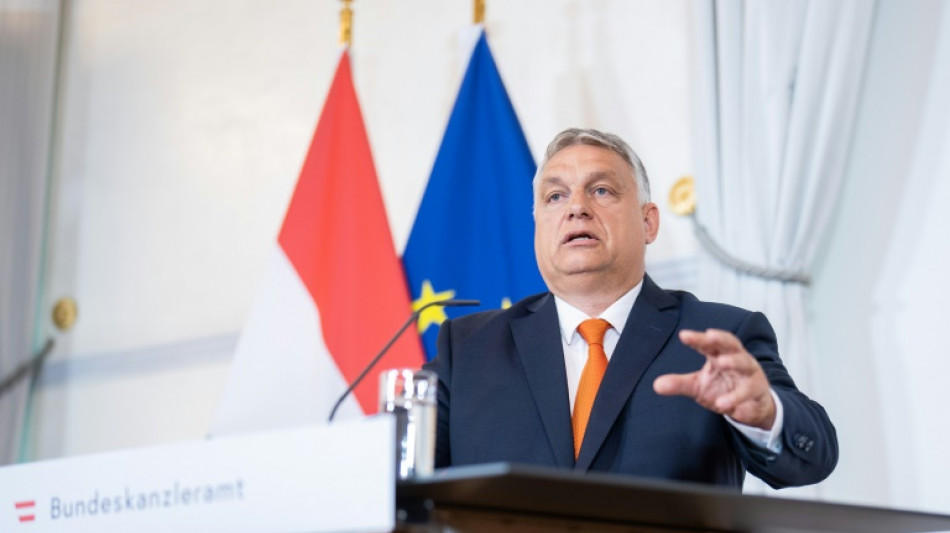
Hungary's anti-graft measures to get blocked EU funds / Photo: © APA/AFP/File
The government of Hungarian nationalist Prime Minister Viktor Orban is proposing a raft of anti-graft measures to unlock billions of euros in blocked EU funds as the country confronts an economic downturn.
Here are key questions regarding the issue:
- What to expect from the reforms? -
The government tabled amendments in parliament on Monday with more to follow on Friday for a total of 17 key changes, which are expected to be waved through.
The measures aim to create independent anti-corruption watchdogs to monitor the use of EU funds and make the legislative process more transparent.
They follow a proposal on Sunday by the European Union's executive arm to suspend 7.5 billion euros ($7.5 billion) in financing for Hungary.
The proposed suspension is over concerns that Orban, who has ruled Hungary since 2010, is undercutting the rule of law and using EU money to enrich cronies.
On Thursday, the European Parliament declared that Hungary was no longer a "full democracy" -- a symbolic vote that infuriated Budapest.
Miklos Ligeti, head of legal affairs at the NGO Transparency International Hungary, said under Orban checks and balances had been dismantled and "a highly dysfunctional rules system" put in place.
"There is no way of getting rid of the systemic corruption just by changing some laws," he told AFP, adding "not much can be achieved".
Transparency International ranks Hungary as the second lowest in the EU in its corruption perception index.
"Orban cannot really afford professional anti-corruption scrutiny as too many relatives and personal friends are involved," said Peter Akos Bod, a professor at the Corvinus University of Budapest.
- Will it convince the EU? -
While the European Commission is "under pressure" to get Hungary to reform, it "does not have many tools at its disposal", said Eulalia Rubio, a senior research fellow at the Paris-based Jacques Delors Institute.
The final decision on the commission's proposal to suspend funds will be taken by EU states within three months.
"The European Union does not want to take a decision that will have an impact on the population," Rubio told AFP.
It also does not want to alienate Hungary as Budapest "can harm other negotiations", she added, such as rejecting more sanctions against Russia over its invasion of Ukraine.
The EU would have to decide on the commission proposal via a qualified majority vote, which requires 15 of the 27 countries representing a total of at least 65 percent of the bloc's population.
Poland -- another eastern EU member accused of flouting the rule of law -- said it would fully oppose any measure depriving Hungary of the funds.
- Why does Hungary need the funds? -
As the rest of Europe, Hungary's economy has been hard hit by ripple effects from the Ukraine war, with a weakening currency and fast-rising inflation.
The central European nation of 10 million people depends heavily on EU funds, according to experts.
Akos Bod, who was a central bank governor in the 1990s, said the funds were "badly needed", with Hungary risking to have its credit rating downgraded.
"A downgrade may provoke capital flight and certainly further depreciation of the Hungarian forint," he told AFP.
Opposition politicians have painted a dark picture.
"The country is starting to shut down due to lack of money," European Parliament member Anna Julia Donath said in a social media post.
"We're in big trouble, and they know it," she added.
Hungary is also the only country still waiting for the green light from Brussels on its post-Covid recovery plan with 5.8 billion euros pending over corruption concerns.
A.Wood--TNT