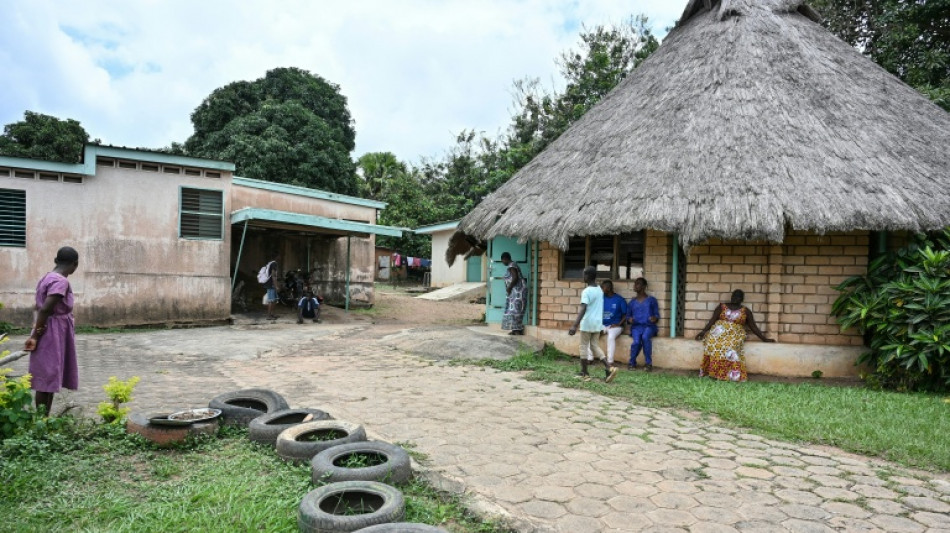
I.Coast refuge offers lifelong care for youngsters scorned as 'sorcerers' / Photo: © AFP
Ahou Albertine Kouadio says it's tough leaving her son in care but it's the safest place for him in Ivory Coast, where youngsters with developmental disorders face rejection, violence or even death.
After having him at home over the holidays, the 70-year-old dropped Alexandre off at a care centre in the country's second city, Bouake, where he stays for the rest of the year.
"That way, when I'm not around anymore..." Kouadio said, her voice tailing off as her tears welled up.
The United Nations says Africa woefully lacks action to integrate the more than 80 million people living with disabilities on the continent, where children with disabilities are often spurned.
The need is nothing short of an "emergency", according to the recently established RAIPH network, which brings together organisations, activists and experts to raise awareness, advocate and help train.
Alexandre has a place at one of the west African country's few specialised centres, which provides residential care for 31 people with developmental disorders ranging in ages from eight to 60.
Nearly 100 others regularly come to take part in activities at the Arche centre, which opened in 1974 and is part of a federation with sites in 38 countries.
Putting him in the centre -- and for several years now -- was "difficult", said Kouadio, who also has other children.
But keeping him at home would be a constant worry.
- 'Genies and snake children' -
In Ivory Coast, as in other African countries, children with a disability are often described as "genies", "sorcerers" or -- for those with mobility issues -- "snake children".
With very few state-run health facilities available to treat developmental disorders, youngsters are often sent to unconventional religious retreats to be "cured".
In extreme cases, they are "accompanied" -- meaning killed, often by poisoning or by drowning, Arche's director Celestin N'Goran said.
"I'm happy when he's here," Kouadio said, sitting beside Alexandre, who will soon turn 30 and has at times wandered out of the house at night.
Older resident, Odette, whose name AFP has changed for her safety, first came to the Arche centre as a young child.
Both her parents are dead and she has no other family to visit her.
She repeats over and over the name of her village when she wanders around outside in the courtyard.
Some of the children came to the centre when they were very young and no longer have any contact with their families.
- 'Right to life' -
"The children aren't sorcerers or genies," N'Goran said.
"They are fully fledged human beings who have a right to life. We must respect their dignity and include them in society."
Those at the Arche centre, most of whom are on neuroleptic (antipsychotic) medication, do activities such as learning the alphabet, colouring and market gardening.
Staff from the centre regularly follow up with the families too, to see "whether these children are able at home to keep up with what we teach them here", social worker Marine Tardy Kouame said.
Through awareness programmes and support groups, she encourages parents to "accept their children as they are".
Developmental disorders are "not very well known, which is why there are a lot of prejudices", N'Goran said.
They are "on the fringes" compared with other disabilities, he said.
In an opinion piece published in July on the specialist Handinova media platform, RAIPH (African Network for the Inclusion of Persons with Disabilities) referred to an "undeniable normative progress" in Africa but said many difficulties remained.
They include a lack of training for healthcare personnel, too little focus on the issue within national health policies and "persistent social attitudes".
M.Davis--TNT