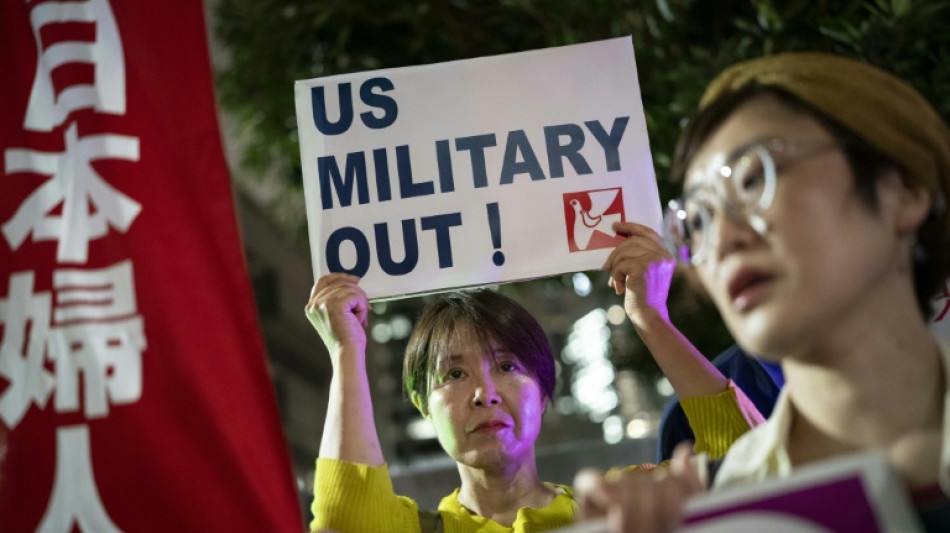
The alleged murder by US marine on Okinawa: five things to know / Photo: © AFP
A woman's murder allegedly committed by a US Marine in Okinawa has triggered public outrage, prompted Japan's premier to slam a "heinous crime" and rekindled controversy over the heavy military presence on the southern island.
Here are five things to know about the latest case and Okinawa's thorny relations with the US military bases.
- What happened? -
Police said Sunday that a US Marine stationed on Okinawa was arrested on suspicion of killing a 39-year-old woman at a hotel in the city of Naha and stealing her wallet.
Local media reported she was choked to death and that the marine is denying the allegations.
- Why are so many bases concentrated in Okinawa? -
Despite comprising just 0.6 percent of Japan's landmass, Okinawa hosts 70 percent of the country's US military bases and facilities.
In the wake of World War II, Japan regained its sovereignty under the San Francisco Peace Treaty of 1952, but Okinawa remained under American control, making it a hub of US military build-up.
The 1972 return of Okinawa's sovereignty to Japan did little to diminish the number of US bases on the island, leading to the disproportionate burden it is saddled with today.
- Why is it so controversial? -
The heavy US presence has led to a host of issues, from helicopter crashes and noise pollution to crimes involving servicemen, including the 1995 gang-rape of a local 12-year-old schoolgirl.
That rape by three US soldiers in Okinawa fuelled widespread calls for a rethink of a 1960 pact that outlined the legal status of Japan-based US military personnel.
Some argue, however, the military bases create jobs and help boost Okinawa's local economy, accounting for around five percent of the region's annual income.
- How does jurisdiction work? -
The 1960 Japan Status of Forces Agreement is often accused of rendering US military bases virtually extraterritorial and immune to Japan's domestic laws.
Japanese authorities are, for example, hard-pressed to conduct an on-site probe into alleged environmental pollution inside the bases and regulate low-altitude flights of their aircraft.
Among the most contentious is Japan's lack of primary jurisdiction over crimes committed by US military personnel while on duty.
Even if crimes are committed while off-duty, as long as the individual responsible remains on base, their custody won't be handed over to Japan until they are indicted, according to the Japan Federation of Bar Associations.
In this case, Kyodo reported that a police officer questioned and detained the suspect as he walked alone on a street in Naha's entertainment district late Saturday.
- How sensitive is the issue for Japan? -
Despite the controversy, Japan -- which has a pacificist constitution -- relies on US military might as a deterrent against any potential attack, stressing the importance of American soldiers being garrisoned, trained and on standby 24/7.
But Japan's safety is not necessarily America's only concern.
Experts say Washington essentially sees Okinawa as its strategic foothold to deploy militarily in the region and beyond, and the island is seen by both countries as important for monitoring China, the Taiwan Strait and the Korean peninsula.
In the past, American troops were mobilised from Okinawa to participate in conflicts such as the 1990 Gulf War and the 2003 Iraq War.
S.Collins--TNT