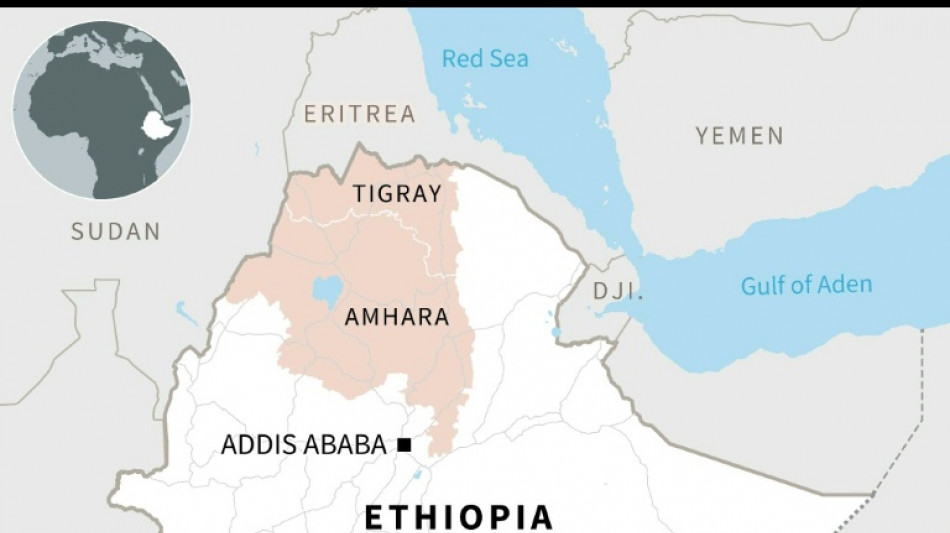
Ethiopia's conflict: the regional dimension / Photo: © AFP
Renewed fighting between the Ethiopian government and Tigrayan rebels has worsened regional tensions, with Ethiopia and Eritrea breaking diplomatic ties on Thursday.
Heavy fighting resumed between federal forces and the Tigray People's Liberation Front (TPLF) last week, and fighting has been ongoing across several fronts in northern Ethiopia.
The geopolitics of the Horn of Africa are fiendishly complex, with shifting alliances and the involvement of many outside actors with conflicting interests.
Here is what is at stake for the countries concerned:
- Eritrea -
Ethiopia accuses Eritrea of backing the TPLF, including with troops, which it has denied.
On Thursday, they expelled each other's diplomats and shut down their respective embassies.
Eritrea gained independence from Ethiopia in 1993, and the two sides fought a brutal border war between 1998 and 2000.
Relations improved markedly with the rise of Ethiopia's Prime Minister Abiy Ahmed in 2018, and Eritrea even fought alongside Ethiopia during the last civil war against the TPLF in 2020-2022.
But relations have since cratered, with Eritrea fearing landlocked Ethiopia plans to invade and seize access to the Red Sea.
"The TPLF is silently allied with its former foe, Eritrea, with supply lines chiefly secured through Tigray's northern border," the Chatham House think tank said in a report.
Eritrea's "priority is to keep war away from its own territory", it added, before cautioning the country's actions increase the risk of regional escalation.
- Sudan -
The Sudanese Armed Forces (SAF) have close ties with the TPLF and Eritrea. Tigrayan fighters have reportedly fought with the SAF in Sudan's civil war.
Ethiopia is accused of assisting the United Arab Emirates in supplying the SAF's opponent, the Rapid Support Forces (RSF), which it has denied.
Sudan was accused of funnelling weapons and supplies to the TPLF during the last war. There were clashes along the shared border in August, suggesting it remains an active concern for the Ethiopian government.
- Egypt -
Egypt is strongly opposed to Ethiopia's new Grand Ethiopian Renaissance Dam, which it says will affect downstream Nile waters. It has forged closer ties with Eritrea and Somalia in an apparent anti-Ethiopia front.
Ethiopia expelled an Egyptian diplomat on Thursday, without giving a reason. Cairo responded by expelling an Ethiopian diplomat.
- United Arab Emirates -
The UAE has invested deeply across east Africa as it seeks security partnerships to counter rivals and control the Red Sea, as well as agricultural land, and investments.
It has been one of Abiy's principal backers, giving him a $3 billion loan and investment package when he came to power in 2018, and building his giant new palace in Addis Ababa, as well as providing military drones and logistical support during the last civil war.
In return, it is alleged that Ethiopia has helped funnel arms to the UAE's allies in Sudan, though that is denied by both countries.
- United States -
Washington was closely involved in the peace deal that ended the last civil war in 2022.
Its focus has lately been on the Red Sea -- and its efforts to contain Iran and its proxies. As a result, it allowed sanctions on Ethiopia and Eritrea to end, with the ill-timed claim that the "national emergency... has expired".
- Somalia -
Ethiopia's relations with Somalia were ruptured in January 2024 when Addis Ababa signed a sea-access deal with the breakaway region of Somaliland.
Relations were ultimately restored with Turkish mediation and the deal with Somaliland seemingly put on the back burner.
M.Wilson--TNT