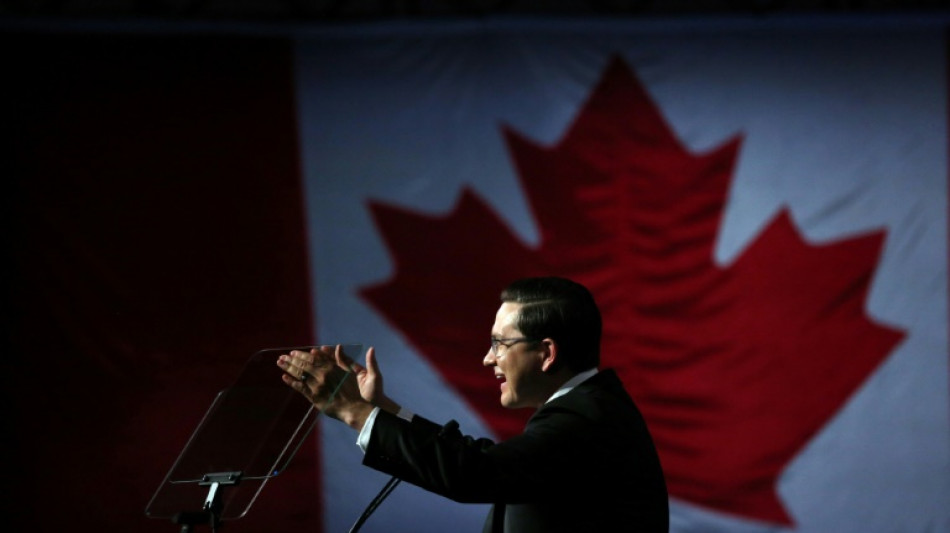
Poilievre: Canada Conservatives' new right-wing leader / Photo: © AFP
The new leader of Canada's Conservatives is a right-wing career politician with a flare for zingers who has already boosted party membership, and now he is set to challenge Justin Trudeau in the next election.
When that comes, likely in 2025, Pierre Poilievre -- who campaigned on tracking the party to the right -- would become the fourth Tory leader to face off on the hustings against the liberal premier.
Born in Calgary and given up for adoption by an unwed teenage mother, Poilievre was only 25 years old when he entered politics in 2004, and has been elected seven times to represent a suburban district of Ottawa.
In 2018, he married a former Senate aide Anaida Galindo, who emigrated with her family from Venezuela. They have two children, Valentina and Cruz.
He twice served as a junior minister before Trudeau took office, but prior to his successful leadership bid at age 43, he was best known for his dogged and witty attacks in parliament.
He outpaced five contenders for the top Tory job by railing against inflation and Covid vaccine mandates, promoting crypto currencies and pipelines, and backing the trucker-led protest convoy that occupied the capital in February.
- Large crowds -
He's drawn large crowds at town halls and many viewers to his cheeky online videos -- carrying his wife piggyback, and explaining long lines at passport offices, for example, as an invitation to "go camping" in government lots.
He also increased the party's membership to a new high.
At his last rally in Victoria, he accused Trudeau, who deployed emergency measures to clear the truckers, of "leaving people feeling bullied and powerless."
"I will be Canada's anti-woke prime minister," he tweeted.
Kim Bathija, a suburban Toronto mother of two, told AFP that Poilievre's messaging on pocketbook issues and less regulation resonates with her.
"Nobody likes being told what to do, or that their government can't do anything for them," she said, pointing to Covid-19 mandates and soaring consumer prices.
University of Alberta professor Frederic Boily described Poilievre as a "protest populist" who has tapped into anger and frustration that started in oil-rich western Canada over climate actions, and burgeoned during the pandemic against what some saw as tyrannical public health lockdowns.
Ottawa University professor Genevieve Tellier said Poilievre -- despite his years in politics -- brings a "fresh, young face" and is far more charismatic than his predecessors.
"He's very much on the right and wants to bring the Conservative Party in line with Western provinces and the oil and gas sector," she said.
- Too polarizing? -
But he's not an ideologue, both academics agree. "Poilievre doesn't talk about identity politics, like Marine Le Pen in France, for example," said Boily.
Still, his critics accuse him of emboldening political fringes, as he seeks to undercut upstart far-right parties blamed for recent Tory losses at the ballot box, by splitting the vote.
Progressive conservatives have threatened to quit the party, which Senator Marjory LeBreton said in an essay is "in the throes of an identity crisis."
MP Michelle Rempel Garner, who backed a rival for the leadership, said there's a "lack of consensus on critical issues" within the party marked by "nearly missed physical fights, coups, smear jobs, leaked recordings and confidential emails."
Celebrity businessman Kevin O'Leary in an email to party members called Poilievre "too polarizing" to win a general election.
Tellier and Boily suggested he would need to nudge the party to the center to win but then risks alienating his base.
Recent polling has shown the electorate is primed for a change in government as Trudeau heads into his eighth year in power.
The Tories and Liberals are statistically tied, while Trudeau's personal rating is at its lowest since his landslide win in 2015, Tim Powers, head of Abacus Data, told AFP. "So he's vulnerable."
At the same time, he added, "Poilievre may be popular in conservative circles and may have some wind in his sails, but for the broader public he's a still-to-be-written book."
R.Campbell--TNT