Researchers brave relentless violence to work in DR Congo
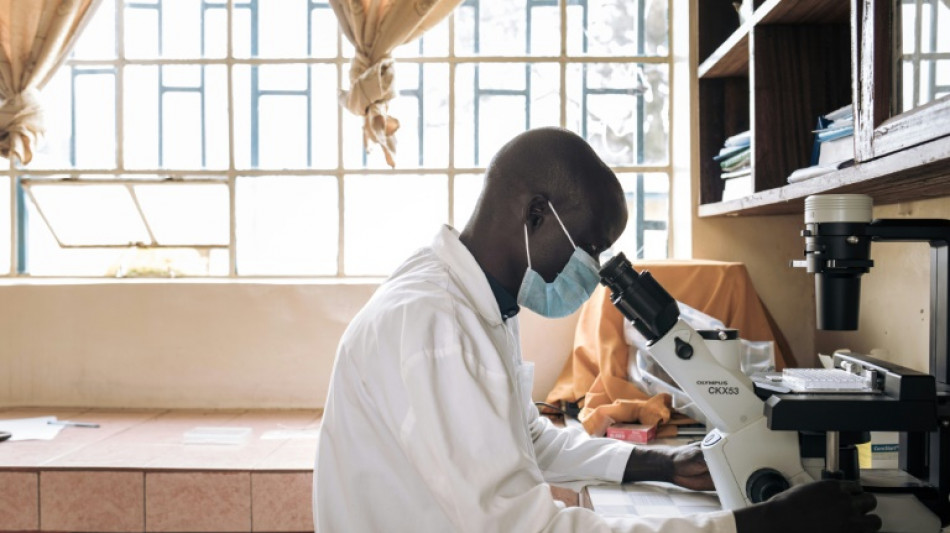
As Tony Ukety peers into a microscope in an effort to wipe out a devastating tropical disease, he is acutely aware that there is a more immediate threat looming outside the walls of his research centre.
It comes from the militia groups who have wrought terror in the Democratic Republic of Congo's northeastern province of Ituri for more than four years.
The violence in Ukety's remote area, Djugu territory, is so bad that it is too dangerous to reach his lab by road.
Instead, the facility is reached by a 12-seater Cessna, piloted by American pastors.
It takes off from the provincial capital Bunia, flying over hills studded with displaced people's camps, before landing a half-hour later near the Protestant mission at Rethy, near the Ugandan border.
Enemies for Ukety, whose lab opened there in 2009, are the larvae of microscopic parasitic worms, transmitted by flies.
They develop inside the human body, causing a sight-robbing disease called river blindness, formally known as onchocerciasis.
According to the World Health Organization (WHO), 14 million people, most of them in tropical sub-Saharan Africa, suffer from the horrifying ailment.
Ukety's Centre for Research in Tropical Diseases (CRMT) is leading clinical tests of a key treatment.
The drug is moxidectin -- an anti-parasite formula approved by the US Food and Drug Administration in 2018.
The first new weapon against river blindness in 20 years, moxidectin is undergoing longer-term tests to fine-tune its effectiveness.
But to do so, scientists have to find volunteers "in areas where nobody has been previously treated," Ukety said.
And this is where the area's extreme isolation, as a result of poor security, turns out to be a blessing.
- Too risky -
Gathered on a January day just outside Rethy in the village of Kanga, a team of scientists was hard at work after a month of forced rest.
"Because of the militia attacks, all the inhabitants had left," and travelling to villages was too risky anyway, said Innocent Mananu, an ophthalmologist on the team.
At the Kanga clinic, the researchers were recruiting volunteers for the study.
Participants took a clinical and ophthalmological exam. Skin samples were then taken to be tested for microfilaria larvae.
Back at the CRMT, lab chief Joel Mande scanned the samples with the latest in microscope technology.
Away from his work, the microbiologist wears another hat as the head of an administrative territory, the Walendu Tatsi, whose inhabitants are mainly members of the Lendu ethnic group.
The area is a stronghold of an armed political-religious sect called CODECO.
Its innocuous-sounding name -- the Cooperative for the Development of the Congo -- belies a bitter ethnic feud between the Lendu, which the group claims to defend, and the Hema community.
Mande has to walk a fine line.
If he gets too close to his study subjects, the authorities may accuse him of fraternising with CODECO.
But if he is deemed to be too pro-government he risks being accused of betraying the Lendu cause.
- Young, stoned, armed -
CODECO fighters can be found less than three kilometres (two miles) from Ukety's lab. They are young, armed, drunk and high on marijuana.
They control all the access roads to nearby Kpandroma and extort money at markets and checkpoints that they set up along roads.
A dozen soldiers are also on hand ostensibly to keep order but, lacking resources, yield to the CODECO.
AFP met some commanders of CODECO's main faction, the Union of Revolutionaries for the Defence of the Congolese People (URDPC), which claims to have more than 30,000 fighters.
The meeting took place at a disused hospital, which troops pillaged in 2020, located at Linga some 20 kilometres (12 miles) south of Rethy.
The militia have in recent months been accused of carrying out massacres in camps for displaced members of the Hema community.
Since the long-running ethnic conflict flared anew in 2017, hundreds of people have been killed and more than 1.5 million have fled their homes, according to the Danish Refugee Council.
Back at his research centre, Ukety holds the line.
"The militia's incursions have affected our activities a bit. But we are still here and we are going to see things through," he said, with his study still two years from completion.
A.Little--TNT