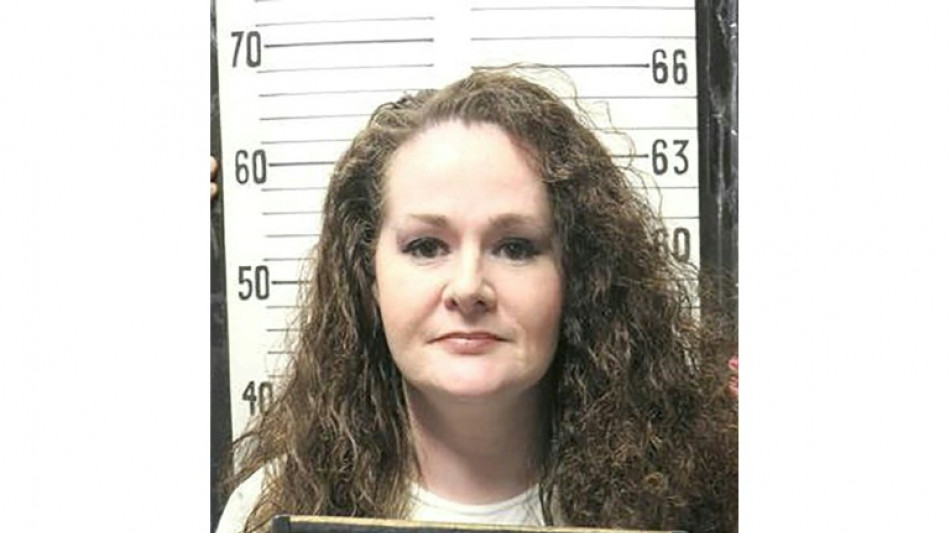
Tennessee woman in hospital after execution 'failed': lawyers / Photo: © Tennessee Department of Correction/AFP
Tennessee woman Christa Pike was in a hospital Thursday after authorities "failed" to carry out her execution, her lawyers said, with witnesses reporting the convicted murderer was breathing despite the injections intended to kill her.
Just hours earlier the US Supreme Court cleared the way for Pike to be the first woman to die by lethal injection in the southern US state of Tennessee in 200 years.
Tennessee corrections officials did not publicly confirm the outcome of the execution, which included two injections of pentobarbital, or respond to an AFP query seeking information.
"Tonight the State of Tennessee once again failed to carry out a lawful execution," Pike's attorneys said in a statement. "Christa is being treated at a nearby hospital. We have not been informed as to her condition."
Pike was scheduled for execution at 10:00 am (1500 GMT) at the Riverbend Maximum Security Institution, where witnesses including journalists were present for the administration of the injections.
"It appears this did not go how this was supposed to go," said investigative journalist John North of WBIR who was a witness at the execution site, adding "when we left the building, so far as we knew, she was probably still alive."
During the livestream, an ambulance with its lights flashing could be seen leaving the site of the execution, it's unclear if it was transporting Pike.
The execution procedure went ahead hours after the US Supreme Court ruled that it could proceed, with liberal justices Sonia Sotomayor, Elena Kagan and Ketanji Brown Jackson all dissenting.
"The Court's decision... unnecessarily prevents that [lower] court from giving due consideration to Pike's claim," the dissenting justices wrote.
"Worse, the Court grants such extraordinary relief solely to allow the State to execute Pike before litigation over her conviction has properly run its course in the lower courts."
- Mental health considerations -
The case has sparked debate over capital punishment for young criminals.
Pike was 18 when she and her boyfriend beat and killed Colleen Slemmer, 19, at a job training camp for young people.
The killing gained national attention after Slemmer's body was found with a pentagram, often seen as a satanic symbol, carved in her chest.
Pike's lawyers argued she should be granted clemency due to her young age and mental health issues at the time of the killing.
"She was 18 when she committed her crime, and she was deeply mentally ill," they wrote in a clemency petition to Tennessee Governor Bill Lee, who said he would not intervene.
The US Supreme Court had rejected Tuesday an application for a stay of execution, which argued that Pike's history as a victim of sexual assault, post-traumatic stress disorder and a blood condition meant a lethal injection would cause "needless suffering."
Independent UN rights experts have urged the US government and Tennessee authorities to "immediately halt" the execution and commute her death sentence.
"Pike's execution would mark the culmination of a trajectory of severe physical and psychological suffering marked by childhood abuse and nearly three decades of solitary confinement on death row," they said.
In the United States, only 18 women have been executed since 1976, according to the Death Penalty Information Center.
S.Collins--TNT