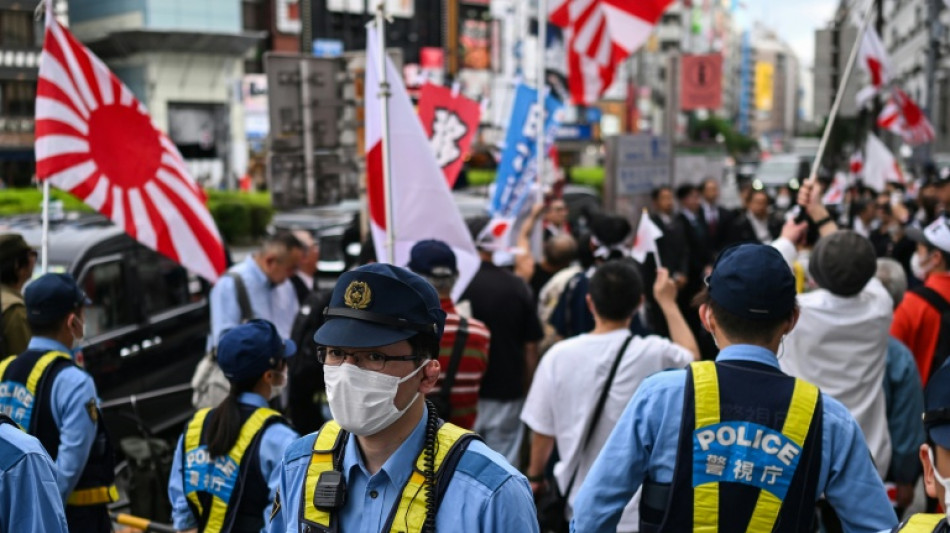
Japan tightens rules for foreigners wanting permanent residency / Photo: © AFP
Japan toughened on Thursday requirements for foreigners wanting to obtain permanent residency, as part of Prime Minister Sanae Takaichi's push to tighten immigration controls.
Under new rules that will come into effect in stages, foreign residents wishing to stay in Japan permanently will have to prove their annual income is above average and they can carry casual conversations in Japanese.
Application fees will also rise 20-fold from Thursday and at one immigration office in central Tokyo visited by AFP this week hundreds of people queued, hoping to wrap up procedures before the price spike.
"I understand that over-accepting foreigners... might dilute Japan's unique culture. But at the same time, given its low birth rate and aging population, Japan has to accept foreigners," said American-born university student Yujie Chono, who was among those waiting.
The 22-year-old told AFP, in fluent Japanese, that he had been waiting for five hours to file his paperwork.
Previous guidelines did not lay out specific thresholds for income, pension or language skills.
Even though Japan has a rapidly ageing population and is suffering labour shortages in many sectors, opposition to immigration is growing, prompting a push by Takaichi for tighter regulations on foreign nationals.
"As the number of foreign residents in Japan increases, the government is facing the fact that some citizens feel anxiety and a sense of unfairness," Takaichi said in an extended post on X on Sunday, adding that she was pushing for "orderly coexistence" with foreign nationals.
Programmes to attract international workers have fuelled public worry.
Anti-immigration sentiment has spread across social media and false claims have circulated widely, including that a significant portion of welfare payments in Japan go to foreigners and that they are making Japanese streets less safe.
Experts and many business leaders warn however that Japan must welcome more foreign workers to sustain itself.
Japan needs to open its doors to more foreigners, the Nikkei business daily said in a recent editorial.
"Japan should stop viewing foreigners merely as a temporary labour force and instead promote their long-term settlement by expanding Japanese-language education and improving their treatment," it said.
- Anti-immigration sentiment -
Foreigners were a major issue in last year's upper house election which saw the sharp rise of the "Japanese-first" Sanseito party, which describes immigration as a "silent invasion".
The new rules for permanent residency come after the ruling Liberal Democratic Party last year pushed to tighten regulations for business manager visas, meaning entrepreneurs will be forced to leave Japan if they don't meet the new conditions.
Some foreign residents seek permanent residency to secure long-term stability, employment freedom and to earn trust within Japanese society. Those without permanent residency often have a difficult time seeking mortgages, for example.
Thursday's changes may prevent some people from applying for permanent residency but should not immediately push anyone out of the country.
Under the regulations, the application fee for permanent residency will soar to 200,000 yen ($1,275) from the current 10,000 yen.
Candidates must also show "understanding" of social rules and demonstrate expected pension benefits equivalent to someone who has paid pension insurance for 30 years.
Having lived in Japan for a decade, permanent residency applicant Chono said he saw both sides of the debate but that the country needed young people "to support its future".
"In recent years, I believe there had been a strong push to promote cultural diversity. The momentum has stalled, perhaps, and maybe it may never fully return," he said.
hih/aph/tc
N.Roberts--TNT