With elections ahead, Latvia's Russian-speakers reject Moscow's help / Photo: © AFP
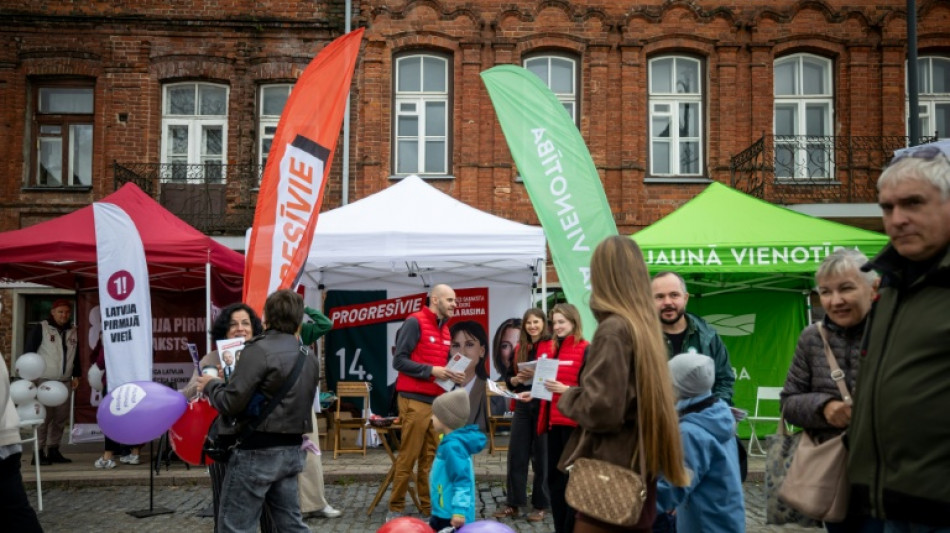
Smoked sausages and homemade cheese enticed locals at a harvest festival in eastern Latvia -- spiced up on this occasion by the campaign speeches of election candidates, including ones from pro-Russian parties.
But like the local produce, many members of the Russian-speaking minority in the town of Rezekne, less than 50 kilometres (30 miles) from the Russian border, told AFP here that they felt identified with Latvia.
A focus of tension since Russia launched its war in Ukraine in 2022, many in the Russian-speaking community here in the Latgale region said they refused to be "saved" by Moscow, as parliamentary elections in Latvia loom on October 3.
"We do not need help (from Russia) here. We can solve our problems ourselves," one local man, 45-year-old Igors Nazarovs, told AFP, as a local band played in the city's main street.
"This is a separate culture -- a separate land."
Russian leader Vladimir Putin has raised fears in the Baltic states that they too could be a target.
He has claimed the rights of Russian speakers there are being "trampled" -- reminiscent of rhetoric used about Ukraine's Donbas region before his invasion.
- 'Russian world' -
Daugavpils, Latvia's second-biggest city, counts some 80,000 inhabitants, 90 percent of whom are Russian-speaking.
Some Russian speakers there, like Inna Plavoka, said the war in Ukraine caused them to reflect on their identities.
When Russia invaded Ukraine on February 24, 2022, "my life was divided into a 'before' and an 'after'," she told AFP.
"Today, I clearly identify with Latvia and with this country, in no way with Russia."
Editor-in-chief of the independent media outlet Tchaika ("Seagull") in Daugavpils, she believes more and more Russian speakers now think like her.
Before the war she still knew people who believed that Putin would come to Latvia "to save them" by offering them "Russki mir", she said. The expression translates as both "the Russian world" and "Russian peace".
Today, Plavoka says, she does not know anyone who would say: "Yes, I want that."
Recent drone crashes on Latvian territory have also changed people's mindset, she added.
"Everyone understands what this 'Russki mir' really means."
- Portrait of Stalin -
Affection for Moscow lingers among older members of the Russian-speaking population, however.
In the offices of the Latvian Russian Community association, Aleksei Vassiliev, a candidate from the Russian-speaking "Harmony" party, points to portraits of Lenin and Stalin with pride.
"This is the history of people who lived in the Soviet Union," he says.
While insisting he is attached to Latvia, he decries the situation of the so-called "non-citizens" -- permanent residents, mostly Russian-speaking, who failed to meet the full criteria for Latvian nationality and hold no other citizenship.
Having failed the Latvian language and history exams needed for citizenship -- or not taken them at all -- they represent nearly nine percent of the population and are not permitted to vote.
"If they were allowed to vote and if they voted as a bloc, they would be the largest parliamentary group in the parliament," Vassiliev said.
The candidate was also critical of measures taken by Riga since 2022 to reduce Russian influence, which included making Latvian the general language of teaching and removing Soviet monuments.
- 'Propaganda' -
In Latgale, the poorest region of the Baltic states, some Russian speakers condemn European aid to Ukraine.
The complaint ostensibly reflects discontent about local economic hardships rather than direct support for the Kremlin.
Courting this electorate, Vjaceslavs Stepanenko, leader of the local chapter of the populist party Suverena Vara -- accused by its critics of pro-Russian sympathies -- railed against support for Kyiv.
"It would be nice if this aid from European countries were for us," he said.
A few metres away, centre-right MP Juris Vilums of the United List handed out his own leaflets.
Led by Prime Minister Andris Kulbergs, the party dominates the polls and is expected to head a future coalition, maintaining Latvia's current centrist course.
In his view, Kremlin influence persists because of a lack of alternatives: "The major problem... is propaganda," he said.
"For now, we don't have any Russian-language media at the national level," he added, noting that people near the border pick up Russian or Belarusian radio.
While part of the Russian-speaking population "is already integrated... another part is not, and I'm afraid it never will be."
R.T.Gilbert--TNT