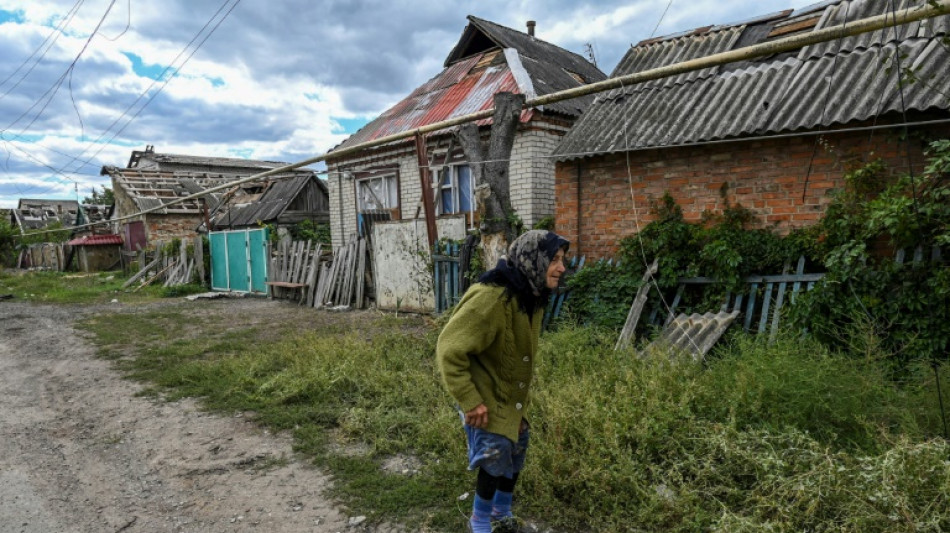
Last residents of Siversk caught in the crossfire / Photo: © AFP
From the hills in the west, the Ukrainian army shells Russian positions. From the east, Russian forces return fire.
Caught in the middle are the last residents of the town of Siversk.
Located in a part of the Donbas region still under Ukrainian control, the town had around 11,000 inhabitants before Russia invaded in February.
There are now just 2,000 -- most of them elderly people who have nowhere to go.
They have been living under constant shelling since the Russian army approached after taking over the nearby city of Lysychansk.
"I live in this madness. We are constantly walking the line between life and death," said Alla, 55, who declined to give her surname.
On the road in front of her home, Alla spoke for her neighbours -- a dozen or so people nodding in agreement around her.
"We live in the cellar. We do not get any humanitarian aid. We're afraid to go into the garden. We have no crop to harvest, no electricity, no water," she said.
"Psychologically, it is very difficult to live with constant explosions day and night... We don't know where they will hit," she said.
- 'I will die in Ukraine' -
As she spoke, several explosions could be heard in the background -- outgoing fire from Ukrainian positions, which quickly got a response from the Russian side.
One neighbour, Viktor Markov, 55, showed AFP a rocket that had fallen recently on an empty house in the neighbourhood.
The rocket, at least three metres (10 feet) long, pierced through the roof and implanted itself in the basement but failed to detonate.
"I was in the Soviet army. I was in some hotspots but I never saw anything like this," said Markov, adding that he could never work out if the shelling was Russian or Ukrainian.
"It puts me on edge," he said on the verge of tears.
"I was born in Ukraine and I will die in Ukraine. We are not against anybody, we are not against the government," he said.
- 'Don't see a great future' -
In another part of the town, where Ukrainian and Russian lines are closer, one in two homes have been completely destroyed.
Tetiana Deinega, 90, who lives in one of the remaining houses, was picking herbs in front of her home -- oblivious to the shelling.
Most of the windows in the house have been blown out.
Deinega said she was waiting for her children, who live in Russia, to come and find her.
"When they will be allowed to come, I will leave. Without them, I'm not going anywhere," she said.
Deinega said she was not lonely and was being looked after by other people in the neighbourhood.
If her children do not come, she said she would stay.
"We believe this is Ukraine, our native land. Whether good or bad, it's ours," she said.
Asked about the dangers of staying, she replied: "Maybe I will go to bed tonight and not wake up tomorrow."
About 15 kilometres away, in the small village of Kalenyky, things were calmer even though the front line is still nearby.
Valentyna, 72, said she was living with no electricity but had a well for water.
The village is intact but there is anxiety.
"I don't see a great future. We will not be able to think about the future until this is all over," she said.
E.Cox--TNT